February 11, 2006

Legacy

I didn't want to write about the whole cartoon "crisis". I really didn't. But something that has been lost in this whole issue has been the Prophet himself, peace be upon him. Not enough people know about this amazing personality, though there is probably no one in history whose life has been recorded as extensively. There is no shortage of material on the life of the Prophet Muhammad, peace be upon him, but there is definitely a shortage of Muslims willing to deliver those materials.

Since at least one person has questioned my imaan altogether because of my lack of outrage, I felt compelled to write on this topic. Others have told me that the worldwide reaction was justified, as defence of the Prophet should be our number one priority as Muslims. Some are outraged that Canada hasn't done enough to make Europe apologize. All this just doesn't make sense to me, even though I did find the pictures offensive and insulting. Personally, I feel that even if every single European nation decided to apologize, there is no way that such an apology would be sincere.

"We're sorry a bunch of cartoonists accused your Prophet of being a terrorist. And thanks to your violent protests, your burning of our embassies, the dozens of deaths which have been caused by your riots, and the death threats we've received, we can now say that we were wrong, and we regret the error."

That seems highly unlikely. I'm not saying that no apology is necessary, but this is not what we need right now; an apology at this point would only be a political gesture that would do nothing in addressing the root problem. It amazes me that this is what it took to finally unite the Muslim world on a common cause, even after we remained silent on much larger issues.

Regardless, I wanted to write about the Prophet himself and leave the politics aside. Regarding provocations and ignorant talk addressed to Muslims, the Quran states:

"You shall certainly be tried respecting your wealth and your souls, and you shall certainly hear from those who have been given the Book before you and from those who are polytheists much annoying talk; and if you are patient and guard (against evil), surely this is one of the affairs (which should be) determined upon." (3:186)

"And the servants of the Most Gracious (Allah) are those who walk on the earth in humility, and when the ignorant address them, they say, 'Peace!'" (25:63)

Regarding the Prophet, peace be upon him, the Quran says:
"And most surely you conform (yourself) to sublime morality." (68:4)

"And We sent thee not, except as a Mercy for all the creatures." (21:107)

"You have indeed in the Messenger of Allah an excellent exemplar for him who hopes in Allah and the Final Day and who remember Allah much." (33:21)

"Say (O Prophet): 'If you do love Allah, follow me; Allah will love you and forgive you your sins, for Allah is Oft-Forgiving, Most Merciful." (3:31)

There are many more verses which illustrate how highly a Muslim must regard the Prophet, and how Muslims must follow him in all aspects of life. There is no doubt that reverence of the Prophet is fundamental, and thus any insult to him is something every Muslim will take personally.

Regarding the Prophets love for his followers:
"Now hath come unto you a Messenger from amongst yourselves: it grieves him that you should suffer, ardently anxious is he over you; to the Believers is he most kind and merciful." (9:128)

The Prophet Muhammad, peace be upon him, was known as a "Mercy to Mankind", but he underwent years and years of suffering in order to guide people to the Truth. Prior to Islam during the early sixth century, the Arabian peninsula was mired in the heights of depravity and ignorance. Outside the Arabian peninsula, the rest of the world was also at a moral and intellectual low. The Sasanid and Byzantine Empires, the dominant world forces at the time, were worn out and weary, as noted by H. G. Wells in A Short History of the World:

"Science and Political Philosophy seemed dead now in both these warring and decaying Empires. [...] In both Persia and Byzantium, it was an age of intolerance. Both Empires were religious empires in a new way, in a way that greatly hampered the free activities of the human mind."

Ancient India, relatively free from the traditional Imperialism of the age, was doing fairly well in scientific fields. Morality was dead, however, and the social conditions were even worse. Women were dealt out and traded in games of chance, the caste system had rendered most of the people into slaves, and lawlessness was rampant. Europe fared no better, caught in their Dark Ages during which men were barbarians, women had no rights, and the religious elite had no morals.

Effectively, the entire world was in the most squalid and humiliating conditions, and there was no reason to believe things would change anytime soon.

Enter Prophet Muhammad, peace be upon him. An entire biography of his life is well beyond the scope of this post, and there are numerous books which can do a much better job than I ever could. However, it should be sufficient to state that within a matter of 23 years, a worldwide revolution had begun that we are still benefitting from today. In brief, Islam conquered the tribalism that sunk Arabia to barbarism, and propelled the land to the heights of enlightenment and progress. The people united, women were honoured, the poor benefitted from generous social programs, and the entire population enjoyed the benefits of a well-governed society which brought them both spiritual and worldly advancement.

Within a century, more than one third of the known world was benefitting from the revolution brought forth by Islam, and the rest of the world started waking up in awe of the massive changes which had taken place.

And it all began with that one man, Prophet Muhammad, peace be upon him, whose mission was only to call people towards their Creator, teach them the Quran, and serve as an example for them. The root was Islam; the fruits were the advancements and innovations brought forth by the rising Islamic world. The Muslim world excelled in math and science; the Prophet was neither a mathematician nor a scientist. The Muslim world excelled in art and literature, though the Prophet himself was unable to read or write. The Muslim world pioneered some of the most important social programs we know today, including welfare and the protection of minority rights. The Prophet Muhammad brought forth all of this change not because he was an expert in these specific fields, but because he brought people towards obedience to their Creator. And the system of the Creator will always benefit the creation; the manufacturer of any product knows best how to operate and maintain their works, and humanity is no different.

One cannot judge the Prophet in the context of the Muslim world of today. It is embarassing to see how so much of the Muslim world is in shambles, but one cannot attribute that to Islam. If anything, it is the lack of Islam, and the lack of respect for the teachings of Prophet Muhammad that has caused the ruination of the Muslim world today.

Prophet Muhammad, peace be upon him, did not effect this change without facing adversity. He suffered much at the hands of his own extended family, and at the hands of the rulers of Makkah during the early years of Prophethood. He was insulted, cursed, and pelted with stones by children at Taif. He was conspired against, slandered, and opposed by people who claimed to be his friends.

He took it all in stride, knowing that he was suffering for a greater good. Instead, he prayed for the forgiveness of those who persecuted him. And as his followers were being tortured, he still pushed on with his mission, and his followers continued to support him. He urged his companions to remain discrete about their Islam so that they would not suffer. But those same companions refused to remain silent about their new way of life, also understanding that their suffering was for a greater good, and that such a valuable gift should never be kept hidden.

When that gift was exposed to the world, the world as a whole benefitted from it.

In the famous book "The 100: A Ranking of the Most Influential Persons in History" by Michael Hart, Prophet Muhammad ranked #1 for turning the world around when it was approaching complete failure. George Bernard Shaw wrote about Muhammad, "I believe that if a man like him were to assume the dictatorship of the modern world, he would succeed in solving its problems in a way that would bring it the much needed peace and happiness."

This is the personality we're talking about, about whom all this debate surrounds. Ignorant insults to him do not lower his stature and legacy in any way, and we will always be benefitting from that legacy whether we know it or not. Learning more about his life is left as an exercise for the reader.

* * *

Regarding the cartoons themselves, Imam Zaid Shakir has written one of the clearest and most reasonable responses to the issue I have read thus far:

Clash of the Uncivilized: Insights on the Cartoon Controversy

Regarding media responsibility on the issue, CBC editor-in-chief Tony Burman seems to have gotten this one right:
Why CBC News Drew the Line

February 08, 2006

Morning

I woke up this morning and looked out the window as I always do. This time, I was met with pitch darkness. I looked over at the clock - nothing. My computer, typically on for weeks at a time, was off. The power was gone.

I headed to the washroom, and flicked the light switch. Nothing. I turned the taps, and a few drops came trickling down the faucet. Finally, the water started spurting out, and I used whatever little remained in the pipes to perform wudhu. Finally, the water supply exhausted, and I was left with only a little lota water. The toilet would not flush either.

After prayer, I stepped outside my 18th floor apartment. There were no lights in the halls, and no power to work the elevators. I could not see anything in the darkness. I went back into the apartment, searching for a flashlight. I knew I didn't have one, but hopelessly searched regardless. Perhaps something was left behind by the previous tenants when I moved in over a year ago. I found nothing, and gave up my futile search after some time.

It was now 7:25am. I picked up the phone to call my supervisor that I might be late this morning. But there was no dialtone - I'm a subscriber of VoIP technology, and thus internet or power outages mean I am also without phone service.

It would have been a difficult trek to navigate my way down 20 floors to the parking garage to get to my car. At this point, I thought to myself, WWBD. "What would Batman do?"

And so I threw a toothbrush, a tube of toothpaste, and some clothes into my bag. I pulled my laptop out of its bag, and powered it up. The LCD monitor provided enough light for me to navigate my way down the dark and dirty stairwell. Finally, I reached the second basement, where the laptop monitor continued to be the only light in the pitch black garage.

I reached my car, and turned on the radio. I heard no sign that this power outage affected anything outside my street, so I decided to head out to work.

Alas, on driving up to the first level of the parking garage, I saw a number of other cars waiting by the exit to leave the parking garage. The garage door was electronically controlled, and we could not open it manually during the power outage. I waited and waited in the parking garage, until finally, building security initiated a manual override of the parking garage controls, allowing the door to open. The garage became flooded with natural light from the outside world, and we all broke free.

I was still in pajamas, however, with an unshowered body housing unbrushed teeth. I could have gone down to my company's main office, but downtown traffic would suck me in. Fortunately, I still had the access card for an old client site I worked at, and recalled that there was a shower there. So I drove down to the old client site, snuck in through the side door closest to the shower room, and got ready. I brushed my teeth, showered, got dressed, and was soon inconspicuously on my way to the office; no one caught me during my brief intrusion.

I drove back down to my current clients office, and reported in for another fun day of consulting. In the end, I arrived only ten minutes later than usual.

January 28, 2006

Education Failing

I'd like to think I'm not that old. I don't feel very far removed from high school, CEGEP and University, but I already find myself sounding antiquated, waxing nostalgic about "back in my day..." I often find myself discussing how children today have no idea about anything, just as my parents probably thought of me and my world. I fear for the coming generation, raised on Google and TiVo, where anything less than instant gratification is not enough. I worry about the overwhelming stupidity which accompanies the high school culture that students are growing up in. I worry about the few options available for Muslim children to be protected from all the nonsense in school.

So when I was asked to help some struggling Muslim middle-school students with English and Math, I accepted without hesitation. The children I am tutoring right now are fairly recent immigrants, and their parents have absolutely no idea about the world their kids are living in. Thus, I take my responsibility as a tutor very seriously; not just as one who can teach grammar and geometry, but as one who made it through that challenge of trying to hold on to some religious values while somehow fitting in.

But even leaving aside all the Islamic/Western culture issues, there is still so much wrong with the way children are being educated today - particularly in Ontario. I recall elementary school evenings when our assigned homework would include answering 50-100 math problems. For us, it wasn't enough to simply understand the concepts - we needed to be extremely efficient in taking numbers and deriving results from them. Multiplication tables were drilled into us. In the end, the students - even the weaker ones - were computational machines with minds that were capable of processing a lot of data. It wasn't fun, and we all hated it at the time.

Today, a typical math textbook is a colourful scrapbook full of pictures of multicultural, trendy teenagers saying things like "Math is cool!" or "I can use geometry to design a ramp for my skateboard!" As I teach my students, I study their textbooks closely; looking through them, I realize that their brains are not processing anything. I had to help one of my students with a problem which involved putting together a ramp for a circus trick; underneath the ramp, there had to be room for a performer to hide. Without giving any numbers except for the cost of materials - 16.50$/m2 - students were asked to "discuss" how the performers should design the ramp. In the end, there are rarely actual answers - just "discussions". While it may sound like a good idea to have students discuss applications of what they study, no students actually discuss these things; in the end, they don't actually do anything except draw a few pointless diagrams. Unfortunately, this is usually enough to give them the marks they need. As Calvin correctly observed, all students are learning is how to manipulate the system.

I had the fortune of having some excellent English teachers throughout high school and CEGEP. When I entered high school, I was admitted into the advanced program. As a grade seven student, highly experienced at the age of 13, I was insulted when our Advanced English teacher told us she was going to teach us grammar. My classmates and I thought to ourselves, "what do we need grammar for? We're the smart students!" Little did we know how much we had to learn. And while students of the regular English classes laughed at us for learning grammar, I knew that I was learning something valuable. Ultimately, I learned more in that one year than many of my friends learned throughout all of high school.

During CEGEP, I participated in the John Abbott College Writing Tutors programme, a special English course reserved for the better writers in the college. Our professor did not teach us classical literature or essay writing; she taught us how to teach. Our reading material was a combination of timeless essays about writing itself, and a collection of poorly written student essays. Our job was to understand where other students struggle, and how to rectify their situation. She taught me that critical thinking was something that can be taught, and that it is the foundation of all writing skills. She used to rail against the education system for assuming that Anglophone students will know how to write English, and for failing to teach grammar and critical thinking from the outset.

The students I teach, in grades 7 and 8, have never learned grammar. When I told them that I was going to teach them as I had been taught, they thought I would be wasting their time as it appeared to be unrelated to what they were actually doing. (What one was actually doing was making a bristol board presentation about the top ten events in his life during 2005 - the sort of mindless busy work that my Writing Tutors professor cringed at.) I quickly discovered, however, how important it was - they could not determine which words were nouns, adjectives, or verbs in a sentence. Seemingly, they had never been taught these terms, though they had been educated in British Columbia for 4 years prior to coming to Ontario in 2004. Today, I feel a sense of pride when my students can pick out not just basic word types, but can also identify different types of phrases, understand how appositives are used, and identify subjects and predicates in any sentence. My next lesson is on dependant and independant clauses.

The main objective of all of this is to eventually bring the students to a point where they can critically think about an issue, and articulate their feelings about these issues. I once had a discussion with a friend about the importance of teaching Critical Thinking from a young age. This friend grew up in Saudi Arabia, where Critical Thinking was never taught - in any language. I have spoken with many other immigrants who all attest to the fact that they were never expected to objectively analyze opinions or literature; they were only expected to write gramatically correct sentences. None of them ever understood logical fallacies until learning about them in University, nor did they learn how to structure arguments, or how to maintain a cohesive thesis. These things simply were not taught. Somehow, this eerily reminded me of Orwell's 1984, where the vocabulary itself prevented citizens of Oceania from formulating critical opinions about their society.

I have no real background in Education, nor have I ever been at the front of a classroom teaching 30-40 students simultaneously, so perhaps my lofty ideals on education are not practical on a large scale. I still feel, however, that there is so much more that can be done. Children should not be using calculators in the second grade. Children should not be relying on computer spellchecks and grammar checks from such a young age. Children need to learn that there is more to research than Google and Wikipedia. Something must be done to challenge these young minds to prevent the stagnation that will likely occur otherwise.

I may continue along this theme with a later post, as I haven't even started on the social aspects of high school education. That's where things really get messy.

January 24, 2006

Morning

I woke up this morning and looked out the window as I always do. I looked upon the Canadian Parliament buildings, the famous Peace Tower rising above downtown office buildings. The flag perched above the tower blew in the wind, much like it has every other day.

Much has changed beneath that tower and flag, but the structure remains the same. The surroundings remain the same. The country looks the same. For the most part, the people have not changed. The government may have changed, but many things remain constant. My neighbours still smiled in the hallways. Strangers still chatted merrily on the bus. The Ottawa Senators beat the Maple Leafs again. Unfortunately, the Habs kept losing.

I stepped outside; the weather was warm, only a few degrees below zero. I slept well the night before; I was ready to put in a good days work.

The election may not have gone as I hoped, but things aren't so bad after all.

January 13, 2006

Jamarah Plans

I'm thankful that last years Hajj was incident-free. Though pushing through the floods on the last day was exhausting, we did not encounter any major difficulties. I have a lot of family and friends attending Hajj this year, and pray that everyone is safe after the deadly stampedes yesterday. May Allah grant Paradise to all those who lost their lives during this journey.

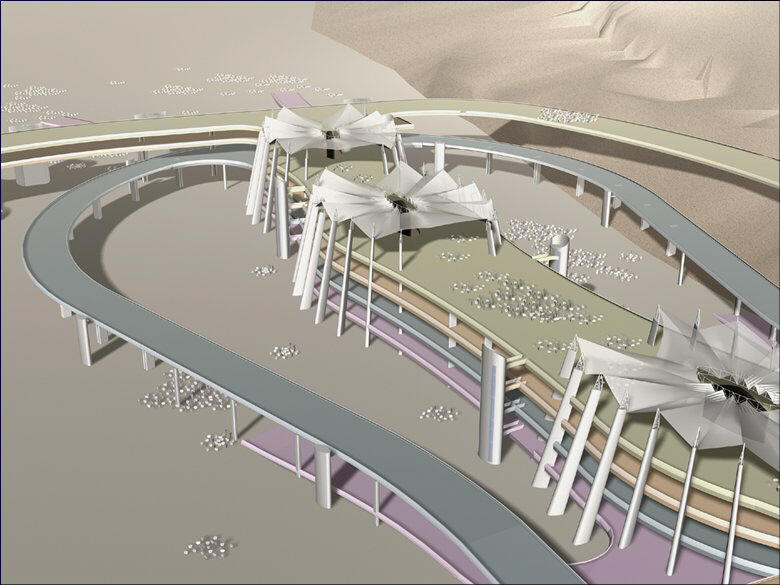
Several months ago, I received some pictures of the proposed redesign to the Jamarah area. These plans have been approved, and insha-Allah should be in place for next years Hajj. I have also heard people suggesting a monorail system to connect all the major sites of Hajj. If it can be designed well, this should help alleviate the insane traffic around Muzdalifah, Arafah, and the surrounding areas.

Top View of the redesigned Jamarah area.


Another top view.


A model of the current setup.


In the end though, somehow I feel that there will always be some tragedies associated with Hajj. Just one hundred years ago, getting to Makkah and Madinah from anywhere outside the Arabian peninsula must have taken weeks or months; now, you can be there from anywhere in the world in less than two days. But the Hajj is not meant to be a holiday; it is all about sacrifice and undergoing hardships for the sake of Allah. Somehow, there will always be some difficulties.

Havelli

The Child circled around the empty rink a number of times, dragging his feet along to the cries of the Coach.

"Be like Lemieux!", the Coach cried. "Be Jagr! Be Spezza!"

The Child found some determination hearing the names of his modern heroes, kicked his skates back, and rushed towards the puck. He pushed forward and handled the puck with his stick and then focused squarely on the empty net. Pushing the puck from side to side, the Child reached the slot, and fired a shot towards the net with all the force and aggression he could muster.

He missed completely. The puck bounced off the corner, and settled in the snow along the boards.

"Go after it!" cried the coach.

The Child grabbed the puck from the corner, circled around, and fired another shot at a sharp angle. He missed completely.

The Child looked back at the Coach while skating towards the puck on the other side. With his eyes focused squarely on the Coach, he fired another shot. Again, the puck went nowhere near the net.

Dejected, the Child skated back towards the bench. The Coach frowned, but was not ready to give up hope.

"If you take a thousand shots, eventually one will hit. Just keep shooting," the Coach instructed. "You will score."

"What about the nearly thousand times I miss though? Someone else will grab it, I might hurt someone, the other team can pick it up, people will laugh at me..." The Child wasn't too keen on this strategy. Nevertheless, it had worked for the Coach before.

"Never mind about that; come, we'll take a break. Let's grab some food." The Child skated off the rink, pulled off his skates, and put on a pair of sneakers. The two walked towards the lobby, and spotted a café therein.

The Coach was also the Scout, looking for the final member of the local Womens team. The Child took a seat with the Coach in the arena café, buying a hot chocolate while the Coach ordered a sandwich.

The Child could not wipe the frown from his face, thinking back to all the shots he missed. To have been practicing this long, and not hit the net even once was something that did not sit well with him. A year earlier, he had hit a post. He still thinks back to that with mixed feelings of optimism and regret. Optimism, because it was the closest he had ever come, but the regret overpowered the optimism. He had never come any closer. The Child sat there, moping about the lost opportunities and failed attempts he was becoming accustomed to.

A young woman, a pair of skates tied over her shoulders, came to the café and sat down at the table behind the Coach and the Child. The Coach nudged the Child out of his moping, and pointed towards the young woman seated behind him. "She might be the one," the Coach whispered, gazing at the woman seated behind the Child. "She might be the right one," the Coach repeated. "I'm going to ask her."

Already, the Coach had it figured out. As a Scout, the Coach had enough experience in assembling the rest of the team, and could identify the characteristics that were needed to fill in that last gap. Yes, this woman might be the one, streaking down the left side, taking a crisp pass from the centre, pulling a tricky move around the defenceman, and putting the puck home past the goaltender. The Coach could already see it; where she would play, how she would fit in. Should she be made the captain? She's probably too young for that. But she'll be good. Maybe someday. She's probably had a very good history. It looks like she's played with some other great players; there were others who had walked into the café with her that also looked good. She definitely has the potential to be the star. She's got it all; talent, charisma, and charm. She will be front and centre on the team picture, the Coach thought.

"You can't just ask her," the Child whimpered. "What do we know about her? Nothing!"

"There's nothing wrong in asking," the Coach told the Child. "If you take a thousand shots, eventually one will hit." The Child thought back to the first several shots he had taken; statistically speaking, things did not look good.

With that, the Coach stood up from the table, and approached the woman.

"I couldn't help but notice your skates. I'm assembling a hockey team and think you might be the one I was looking for to complete it." the Coach asked.

The young woman was startled. "Oh, hockey?" she asked. "Oh, gee, that's nice of you to offer, but I don't really think I would help. I haven't played hockey before, I'm here for figure skating."

Figure skating. "Oh, I see. Well, good luck with that," said the Coach .

The Coach, slightly embarassed, apologized, and sat back down. The Child looked on, somewhat disappointed, but feeling a little smug; he refrained from saying "I told you so", but perhaps his restrained smile gave it away.

The Child later returned to the ice, with the Coach following after. The Child put on his gear, stepped on the ice, and charged towards the lone puck sitting idly at centre ice.

The Coach, rather perplexed by the episode that had just transpired, could not think of any legendary players to inspire the Child as he rushed towards the net with the puck. Inadvertently, the Coach called out to the Child, "Be Chara!"

The Child, puzzled by the reference to the Ottawa defenceman, fired the puck waywards, again failing to come anywhere near the net. He looked back at the Coach, who sat head down, muttering something incoherently.

"Be Chara, child. Be Chara."

January 11, 2006

A tribute to the bugs in my cereal

Part of what inspired me to write that previous post was my frustration with people who pretend to be things they're not. I see lots of these people particularly in Toronto, though this happens everywhere else. In particular, I was tired of seeing people posing as thugged-out gangsters living in ghettos when they actually live in posh, expensive neighbourhoods in suburban Mississauga.

So in tribute to those posers, I present "Bugs in mah Cereal", the thugged-out version, courtesy of the Dialectizer.

Click on the "Dialectize" button for thugged-out fun!

January 03, 2006

Bugs in my cereal

It's been a while since I wrote anything here. It was not for lack of content; recently, there have been many amusing stories in my life that some of my readers already know about. All I will say on that is that there are some search problems even Google can't solve. That's probably a good thing. When searching for your other half, the bumps and bruises along the way usually provide valuable lessons that can last a lifetime. If the results were instant, we'd miss out on one of life's most amusing adventures.

People have assumed that I have been unhappy of late. This is not necessarily true, but I won't deny that my behaviour and actions perhaps reflected an aura of unhappiness. Alhamdolillah, I'm very content these days, but somehow I haven't been able to show that. During my recent Toronto trip, I struggled to show much enthusiasm, which everyone seemed to notice. I'm not sure why; I've never been able to put a finger on it. But thanks to a blog post courtesy of Izzy Mo, I discovered that this feeling has a name; they call it quarter-life crisis.

It is a bit of a misnomer; we can never know what fraction of life has passed, but my understanding is that it represents that little transitionary period in the late teens and early 20s when so many of lifes major decisions come at once. Where is my life going? Am I directing it the right way? Incidentally, it's also the period in which people tend to start blogs, where they ask these same questions to whoever is listening.

Our generation must have invented this term, as we seem to have an obsession with depression. What should be considered as an exciting transitional period has been called a "crisis". Outwardly, we have little reason to be depressed. And inwardly, we don't have any valid reasons for depression either. But when we grow up hearing stupid song lyrics like "I'm not okay!! I'm not okay!" and "Life's not fair!", it is no surprise that when the slightest misdirection creeps into life, we fall into extended bouts of melancholy. Sure, we may live in nice homes in quiet neighbourhoods; we may have home-cooked food waiting for us every day; we may have university educations and challenging careers ahead of us, even. But we still play the victim, secretly seeking sympathy but publicly showing disdain for the world. As soon as conditions appear to be against our favour, we lash out at society for marginalizing us and disregarding our woes. Only in retrospect do we realize how irrelevant our "woes" actually were. We have never seen real adversity, but still believe it's us against the world.

This is partly why the Goth subculture has always fascinated and disgusted me. I've always wondered how so many people can get duped into a culture which unifies only on a colour and a sound; they stand up for so little, yet they attract so many followers. I was mistaken though; it's not the colour or the music which is the unifying force between them; it is the disdain of society, and the attraction towards depression and marginalization. These are often people who really are living privileged lives; I see them on the bus all the time, and I can tell where they live by the bus they take. Many live in half-million dollar homes, their parents are probably engineers, and they have incredibly nice schools and shopping centres all around them.

Still, our generation has created a culture that values being rejected. The Goth culture has responded by reflecting their anger at society by dressing like the Addams family. Another contingent has chosen the path of living the fake thug life. Again, people with all the privileges in the world choose to create this image where they are scorned by society and need to fight back. It's all so artificial, but reality has been losing a lot of battles these days.

The most ironic part of it all is that this disdain for society has been commercialized. Goths chose to express their individuality by dressing against social norms; now, most young people in Ottawa appear to dress that way. There are Goth megastores where you can buy these funky shirts with all the patches and slogans sewed on already. That crazy makeup that makes them all look so pale? Only 3,99$! They bought into the culture to show they were different; in the end, they've been sucked into a commercial jackpot like everyone else. Anti-commercialism itself has been commercialized.

This culture of angst fails because it unifies on something so meaningless. In the end, it will blow away like every other passing phase, and all these people will wonder what they were doing with their lives. They'll realize that this whole venture was a farce, and terms like quarter-life crisis will also disappear. Eventually, economic conditions will become much worse in North America, and we'll be reminded what used to be meant by "Depression". Hopefully, we'll learn to deal with the adversity rather than just mope about it.

Islam thrived because people were uniting on something meaningful; something which not only changed them, but changed society. I once did some research about the Goth perspective on Islam. I came across a messageboard where someone argued that "being Goth transcends all religion; you can be a buddhist, a jew, a muslim, or an atheist, and still be Goth." He added later that as long as the image was right, the ideology didn't matter. The image. That's all it is.

Everyone else is uniting on just an image, though some of them may claim otherwise. (You don't understand man, you gotta feel the music.) As Muslims, we must unite on the values Islam taught us. Those values will reflect on our image as well; indeed, they should. I listened to a talk recently by an amazing local Muslim scholar, who argued against the common refrain of "I've got Islam in my heart; that's all I need." He argued that the Islam in our heart must reflect on our actions, our character, and our appearance. He quoted an ayaah of Quran, where Allah compares the Imaan of a person to a tree, which has strong roots in the ground, outside of view, and branches and fruits springing forth out of the trunk. The branches and the fruits are the a'maal - the righteous actions, the sunnah of Rasulullah SAWS - that are outwardly reflected by those deep roots. Sure, a tree might have deep roots, but if it's not providing fruit, it's no good to anyone.

The challenge then is to decorate the belief in our hearts with the actions required by that belief. It is not enough just to hold the image; that won't last on it's own, just as all of these other cultures based on image won't last. And claiming that our roots are firm while failing to produce the fruits of Islam is also not enough. In the early stages, this tree needs constant care in order to eventually produce those fruits. And once it does, others will benefit from it too.

December 07, 2005

Faulty Plumbing

It has been almost two weeks since I had opinions lacking enough relevance to post on this site. This was the direct result of having too many relevant opinions and contributions towards the launch of the system my team at work had been working on for the last year; almost every night was a late night at the office, with a brief and unplanned trip to Toronto thrown in the middle to further exhaust me. Alhamdolillah, things have relaxed since then, such that I even see the light of day after leaving work.

During this time, a historic motion was passed in the Canadian Parliament, dissolving the existing minority government and forcing another election this coming January. The effective fall of the government was big news, even earning the Top Headline honour on The Daily Show with Jon Stewart and a mention on the Colbert Report; you know a Canadian news story is big when Americans acknowledge it. The election is in late January; the politicians are in campaign mode now.

I don't know who I'm going to vote for, if I vote at all. I won't dwell on specific issues at this time. My qualm right now is not with a specific party or issue, but with the inadequacies of the system altogether.

In almost every field of effort, the best in the field are the ones that move on from one level to the next. In academics, the best students are the ones who advance to the highest levels of education. In sports, the best players reach the professional leagues and represent their countries internationally. In business, the most effective entrepreneurs rise to the top of their profession and end up earning the most money. This is obvious and hardly worth a paragraphs worth of irrelevance.

However, politicians do not follow that trend somehow. Are the leaders of our political parties the best we have? I would hope not! There are very few who trust them, and just listening to them is often painful. Even worse is the political landscape in United States. I'm less bothered by the fact that Bush won their last election than the fact that the only two candidates for the president of the United States were both idiots. Surely, there must have been better people for that job? When politicians have such a huge responsibility to their constituents and the world in general, why are we leaving that responsibility to the gunk in our talent pool?

I already know the answer to these questions, but it still bothers me. It takes a lot of money to start a political party, to promote it, and to bring on the people who share your vision. I'm sure most of us can name at least a few people we know personally who would be very effective political leaders, but the financial barrier is overwhelming. As such, many talented people who could have otherwise been great leaders end up relegated to posting irrelevant opinions on a blog somewhere.

At the same time, there is much to be said about the effectiveness of grassroots, individual efforts. Maulana Ilyas rahmutallahi'alayh did not rely on political power to launch the most significant Islamic revival effort in the world. Gandhi did not need the support of powerful businessmen to fight back British rule. Tim Berners-Lee did not wait for wealthy venture capitalists for his vision of the World Wide Web to come forth. And community-driven open-source software like Firefox continue to chip away at commercial market dominance.

That talent pool is still rich in resources, but leaks with disunity. Unless we can channel those talents in the right places, the world will still be run by a bunch of drips.

November 25, 2005

So it's come to this:
An Irrelevant Opinions Clip Show

Today marks the first anniversary of Irrelevant Opinions! One year ago, I worried that as my University studies were coming to a close, so too would my University website, where I kept some of my writings and a lot of my rantings. As I intended to go for Hajj shortly afterwards, I also wanted a place to collect my experiences for later reference. Most importantly, I needed a way to revive my passion for writing which had wavered throughout the nearly five years of my Engineering studies.

I've never liked the word "blog"; I still don't believe that the idea is so novel that it warrants it's own word. Before blogs, many people were making personal websites on Geocities or whatever, often writing about their experiences; we just called those "personal websites". With the increasing simplicity of on-line publishing tools, everyone jumped on the blogwagon. Eventually, I reluctantly joined them too, albeit much later. Recognizing the vapid nature of most blogs, I decided to call it Irrelevant Opinions, intended to house everything from stories to essays to software reviews. I had hoped that this would be the #1 site on the internet for people in search of irrelevant opinions. For months, this blog never came up on Google search results for 'Irrelevant Opinions', but now, one year later, it makes the first page.

So in the spirit of tired sitcoms that have run out of ideas, let's take a look back at the highlights of the year - arguably the best year of my life.

November 26th, 2004: I receive my Iron Ring, marking my entrance into the Engineering profession! I graduate a month later, with an excellent job already waiting for me. (I lost my Iron Ring on the first day of Ramadhan last month... still haven't replaced it.)

I could write hundreds of posts about my University experiences. Though I don't miss those days much, I had an amazing time and learned so much - both in the classroom and out. More than anything, I learned a lot about myself in living nearly five years on my own, and I recommend anyone considering studies outside their home town to take that opportunity, just for that reason.

January 2005: My mother and I go for Hajj! It was an amazing experience, with the highlight of the trip coming on the last day of Hajj when massive rainstorms caused major flooding around Makkah and Mina.

I didn't expect to write more here after Hajj, but was surprised to see that blogs had become popular among my family when I came back to Canada in April. So all two of my readers got to read my irrelevance for many more months.

April 15th, 2005: Some reflections on my trip to India, including the advice of some amazing scholars I had a chance to listen to. During April and May, I was also in the middle of a two month vacation, away from everything. I took the opportunity to learn Arabic through the Shariah Program on-line courses. I highly recommend those courses for anyone who cannot dedicate themselves to full-time studies.

On May 30th, 2005, the most recent chapter of my life had begun, with the start of my career in Consulting.

July 9th, 2005: A hilarious incident in the wake of the London bombings. Possibly my best post ever, insofar as it elicited a response from one of the best Muslim writers in Canada, albeit an emoticon.

August 7th, 2005: Probably the most frequently discussed piece of writing I have done, once the metaphor kicks in.

September 12th, 2005: Feeling exasperated with some trite Masjid politics and MSA issues, I let loose in my writing for once. I had lost the ability to do that after years of technical reports and little creative work.

October 22nd, 2005: On October 19th, all my co-workers joined me in fasting for one day of Ramadhan. This was the result.

November 20th, 2005: I ended the year on a high note, with the most unique commenters I've ever had on this site. While still extremely few in comparison to the great blogs out there (and many of the stupid ones too), it's nice to know that I have some readership after a year.

November 25th, 2005: In the absence of new, meaningful content, I strung together a years worth of Irrelevant Opinions in commemoration of the one-year anniversary of this site.

November 20, 2005

How Technology has Corrupted Language

Beep. It's from Hamlet. 2B? NT2B?=??? | Yahoo! News

The above news posting made me feel sick. For a while, I considered writing a piece about how instant messaging, e-mail, and SMS has tainted the value of the printed word, but I often felt that the situation was not as urgent as I originally suspected. When I first heard someone actually say "Lol" in a spoken conversation, I knew things were bad, but I thought we were still some years away from disgusting constructions like "2B? NT2B?"

How wrong I was. I'm not part of that generation where computer ownership was considered a luxury for most high school children; we were expected to submit most things typed and printed. However, back then, we still used our pencils most of the time. We were accustomed to writing out entire words, articulating our feelings with a healthy supply of adjectives. Abbreviations were frowned upon, and we were aware that contractions weakened the language already. Consider the following two statements; it is clear which one is stronger.
"I won't eat this spinach."

or,
"I will not eat this spinach."


The contraction used in the first statement weakens the emphasis of the negation; I would expect that with enough coercing, I could convince the writer of the first statement to eat the spinach. The second statement, however, signifies a bold defiance against spinach-eating that one would take all the way to the grave. For example, it would have been much less effective had William Wallace told the Englishmen that "You can take our lives, but you can't take our freedom." in Braveheart. That he explicitly says, "You can not take our freedom" emphatically suggests that this mans freedom was not something he would compromise under any circumstances.

You will not find many contractions in classical texts. They became common because of tongue laziness, as pronouncing too many syllables can quickly become tiresome; now, it is a perfectly common and normal part of speech. Lots of abbreviations have also been accepted as common enough to be used in formal writing. Nowadays, we do not even know what the acronyms mean, but still use them in our writing.

It is possible, perhaps likely, that common internet and SMS terms like "lol", "brb", and "l8r" will embed themselves into regular grammar in the same way. Some may say that this is just the natural evolution of language, and there is no reason to prevent it. However, many of these terms are incredibly stupid and ingenuine, and for the later generations who have been writing like this all their lives, that lack of authenticity will likely weaken the language even further.

Seriously, who actually laughs out loud when they type "lol"? Is there anyone who actually rolls on the floor laughing after typing "rofl"? Originally intended as abbreviations, these have become terms in themselves now which have been corrupted even further through contructions like "lolz", "loooooll!!11", and "rofflez!!"; these are indications that mainstream acceptance of the original terms has already begun. I do not want to even get started on the unpronounceable, meaningless terms like "pwn", which is at least two mistakes away from actual English.

Text messaging on mobile phones, or SMS, has made things far worse. Nowadays, most mobile phones are advanced enough that users can send full sentences, without resorting to abbreviating every second word. However, the culture of abbreviation in mobile technology has been so pervasive that these habits have persisted, and it is considered uncool to actually write out entire words. Grammar and spelling is so 20th century, after all. I remember watching a cousin of mine in India chatting on MSN. When accidentally writing "How are you?", she promptly deleted her last two words and wrote "How r u?" instead. After all, those pesky vowels sure complicate things.

For Muslims, the Islamic greeting of "Assalamu'alaykum" has not been spared from this corruption. This is a beautiful greeting which is shared by over a billion people worldwide, irrespective of language, culture, or sect; there is probably no other phrase in any language which matches the prevalence of this greeting. Every once in a while, however, I will get contacted on MSN Messenger with the message "aa". Many Muslims will reply with "ws", to imply "Wa'alaykum assalam." Our greeting is beautiful, "May Peace be with you." The more people use "aa" and "ws", the more likely this greeting will go the ways of "Bismillahir Rahmanir Raheem", which has been reduced to a meaningless "786" in much of the Muslim world.

For those of you who continue to spell out words entirely in their instant messaging conversations, kudos to you. You will find me responding accordingly. But if you insist on "aa"ing me, then I can not promise you a meaningful discussion. And if you ever say "rofl", you better be rolling on the floor, laughing. Otherwise, I will have a very hard time believing anything else you say.

Update 8.1.2006: Apparently, research has proven my assertions false:
Texting helps teens' grammar | The Globe and Mail

The ironic part is the "verbing" of the word "text" in the title of the article, which is a grammatical failing in itself.

November 14, 2005

This almost makes you want to write buggy code!

When attempting to retrieve a recordset for a web application developed in ASP.NET, I encountered the greatest runtime error ever:

Run-time error '-2147418113' Catastrophic failure
There has been a catastrophic failure. Please stand by.


Catastrophic failure! Run, children! Save yourselves!!

This now surpasses the Quartus "This operation is legal, but highly suspicious" error message I encountered in fourth year university as the greatest error message of all time.

November 11, 2005

The Joys of Multiculturalism

This happened over a week ago, but since everyone found this story funny when I told them in person, it has now officially been relegated to an Irrelevant Opinion. Generally, I'll try to keep work-related stuff out of here, but this is an exception.

I was working on the integration of a third party tool into the system we were developing for the federal government. We had been waiting for months for the company to deliver this product, and finally last week, they told us that it was ready to be tested. We scheduled a conference call between a few of us from our company, with the third party vendor joining us from locations in Toronto and Arizona. I had not met any of these people previously, and didn't know most of their names either.

So after everyone introduced themselves on the call, someone asked: "Do we have a jew on the line?" I gasped, perplexed by the question. "Not yet," another replied.

Later, after our test failed, I was told to "touch base with a Jew" before I continue with my testing. I was confused, but didn't inquire further.

Finally, someone else joined the call. He had a heavy Indian accent, and introduced himself to the rest of us on the conference call.

"Hey everyone, this is Aju."

Finally, it all made sense. A few hours later, I was explaining to others within our company how to conduct the tests I had just run. When I told them to "get in touch with a Jew before you move forward," I was greeted with lots of furrowed brows - their confusion was probably amplified since this was being explained to them by a devout Muslim with a thick beard.

Ah, multiculturalism at work! It's a beautiful thing.

October 30, 2005

Strength in Weakness

I wrote this just a couple of weeks before the October 8th earthquake, as it was to be included in the Ramadhan issue of Muslim Link. I was fortunate to get in touch with one sister from New Orleans to provide an Islamic perspective to the devastation caused by Hurricane Katrina, and referred to Baghdad Burning for the Iraqi perspective on Ramadhan. As I wrote this over a month ago, it might appear slightly outdated with emphasis put on Hurricane Katrina and not on the greater tragedies that have occurred since then, but this blog is called Irrelevant Opinions, so I suppose that's okay. The themes I touched upon for this article are better illustrated by the efforts of the Pakistani relief workers and the resilience of the victims, but here's my essay anyway (slightly edited from the published version.)

At first, it seemed like nothing. Ramadhan 1418 had just begun, and with it, the January temperature was unseasonably warm in Montreal. The winter break was coming to an end, so the students began preparing for school while others prepared themselves for returning to their various responsibilities. It was wonderful to begin the holy month of Ramadhan during the holiday season, since families could be together and share in the blessings that only that month could bring. The end of the holidays meant that most of the Ramadhan days would have to be spent in offices or classrooms, and perhaps the spirit of Ramadhan would be lost amid the hectic schedules.


No one expected the mild weather to cause as much havoc as it did. The rain came down innocently atop the trees and houses, but congregated there as ice; indeed, there were few sights more beautiful than those trees which appeared to be encased in glass, shining under the moonlight. Before long, branches of every tree became crystallized in a thick layer of frozen rainwater. Roofs of houses and cars collapsed under the weight of the ice, with the raindrops accumulating to become several inches thick. Trees that stood for hundreds of years succumbed to the ice, and came crashing down to the ground. And as trees all around the city fell victim to the drops of water, they took down large sections of the electrical infrastructure connecting the city. As each power line came down under the weight of nearby trees, another neighbourhood would fall into darkness.

Nearly the entire city was without power, and then a deep freeze fell upon the dimmed city. Temperatures dropped to twenty degrees below zero, and for the hundreds of thousands of residents accustomed to electrical heating, it became nearly impossible to live at home.

For Muslims, that Ramadhan quickly became unforgettable. Already accustomed to going without food and water for entire days, the experience became even more meaningful when other basic necessities were unavailable. Without light, heat, and electricity, families were forced to go about without the lavish meals and elaborate gatherings that generally accompany the breaking of the fast. In everything, simplicity and efficiency were the order of the day, and some of the deeper meanings of Ramadhan became apparent.

We prayed Tarawih prayer by candle light. Every worshipper stood listening to the words of the Quran wrapped in heavy ski jackets, multiple pairs of gloves and socks, toques, and even snowpants. Inside the prayer hall, temperatures were well below zero degrees, but somehow the beauty of the Quran transcended the extreme conditions, and the masjid remained full in spite of the extreme cold and darkness.

In the trying conditions, families came together, sharing whatever provisions they had. With schools and offices closed, it was perhaps the first time that entire families were able to break their fasts together. In the desperate circumstances, the beauty of Ramadhan was experienced fully.

In Ramadhan 1425, in the city of Baghdad, the circumstances were far worse. There was no end in sight to a war that had claimed the lives of thousands of Iraqis. Widespread chaos reigned throughout the country, and there no reason to believe that things would improve anytime soon.

One sister took her family to visit an aunt who had been stricken with depression due to the continuing occupation. At the time, the city of Fallujah was under heavy attack by occupation forces, thus many Fallujah residents fled to Baghdad. It was then that the sister met some relatives among the refugees. She had never met them before, but the war had brought them together in the home of her aunt. They broke their fast together solemnly, discussing the desperate situation. Among the refugees was a mother and some of her children; the father and one son did not make the trip. They stayed back in Fallujah to assist others in escaping the war-torn city, and had not been heard from in days.

It was Ramadhan, however, and the family from Fallujah vowed to remain patient. Abstaining from food and water was the least of their struggles; living under an occupation, with their family divided and without the means to communicate with them were much greater struggles than the traditional hardships associated with fasting. The families ate together and they cried together, while Muslims around the world prayed that their hardships come to an end.

For thousands of Muslims, this will be the first Ramadhan after being afflicted with the most devastating natural disaster in recent history. Countless Muslims died during the Tsunami crisis at the end of 2004, and over a million lost their homes and belongings. Many will never be able to rebuild their lives. For those who had lost homes and families, the hardships of Ramadhan would be insignificant in comparison. However, the qualities of patience, restraint and steadfastness that Ramadhan teaches are that much more important to those who have undergone such hardships. And in the midst of such overwhelming catastrophe, the most dedicated believers will always find courage in their losses and find strength in their weakness.

Today, the focus falls upon the southern United States, in the midst of the most destructive natural disaster in the nations history. Thousands of residents have been forced to evacuate their cities, and thousands more have lost homes and loved ones. In a nation known for its economic and military power and in a city known for its hedonism, the lessons to be learned are multiplied. Accustomed to its apparent invincibility, the devastation caused by the hurricanes will forever leave a stain on the nations pride.

For the sizable Muslim population living in New Orleans, the catastrophe and the consequent relief efforts have made the coming Ramadhan that much more meaningful. One sister, Kelly Izdihar Crosby of New Orleans, found renewed faith through her ordeal, summing up her feelings as follows.

“After facing the wrath of Hurricane Katrina and the ultimate failure of the relief efforts, I feel incredibly blessed that I am alive, happy and healthy. My faith in Allah Ta'ala has been strengthened, and since we had escaped from New Orleans to Atlanta, we have witnessed the sweetness and generousity of those who are sympathetic to our situation. I have seen an outpouring of generousity and sadaqa which reminds me of why Ramadan is so important.

“This year, when you fast, think about the people stranded behind in New Orleans, who were too poor to evacuate, and had nothing to eat for days. Praise Allah Ta'ala that you will probably break your fast with your loved ones, while many do not know where their next meal is coming. And give with a happy heart, as much as you can, for the pleasure of Allah. Allah will return it to you and reward you for your charity. Loan to Allah a beautiful loan. Thank Allah in your prayers this Ramadhan that you are in a clean home, in a dry land, with people who love you and all your possessions at your disposal. I am sad for my city, but thankful that we are safe in Allah's care.”

And we all must be thankful. We must always remind one another of the blessings bestowed upon us by Allah, lest the reminder come crashing down upon us again.

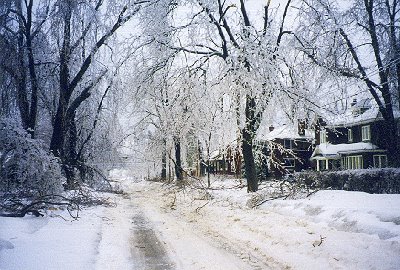
(Irrelevant Note: It would have really been nice if digital cameras were common back during the Ice Storm, because it was so incredibly beautiful and I'd have ice storm pics all over my desktop.)

October 22, 2005

“Ramathon”

Ramadhan is a particularly interesting time of year in the West because religious expression extends over the course of the whole day. As a result, questions will always arise in classrooms and workplaces, such as "Why aren't you coming out with us for lunch? How come you're leaving work at this time? Why are you never home in the evenings?"

Some answer with awkwardness or deliberation, and fail to provide good answers. Consequently, an excellent opportunity for educating people about Islam becomes lost. This feeling generally prevails when we develop a sense of disconnect from the lives and practices of non-Muslims; we feel that since we don't want to be involved with their activities, we don't them involved in our activities. Unfortunately, this only further alienates the community, and makes it harder for such opportunities to arise again in the future. This is a major problem within the Muslim community, and needs to change.

In the past, I've always been fairly up front regarding my beliefs and practices, but this year I wanted to take it a step further. Weeks before Ramadhan began, I started talking about it around the office, in elevators, and wherever else would I find myself. I work for a large consulting firm, and before Ramadhan began, my whole team knew about it and kept asking if it had begun yet.

So when it finally did, I was amazed when some of my non-Muslim colleagues expressed interest in fasting for a day themselves. I did not need to convince anyone or even encourage them, but of their own volition, they agreed to try it at least once. This was an opportunity not only to help others become more understanding of Muslims, but to engage them in a Muslim experience. To this end, I contacted the Ottawa Food Bank to turn this day of fasting into a charity event, where my whole team would fast, and others would contribute to a worthy cause in support of it. I was calling it Fast-a-thon, as the event was similar to ones organized by some MSA's with that name, but others called it Ramathon as an homage to the month of Ramadhan.

We set the day of fasting to be Wednesday, October 19th. I did not want the fasting to affect the productivity of my colleagues, so I told them that they could cheat if they really needed to, but they insisted on going through with it fully. On that day, they all woke up at 5:30am for an early meal, and then fasted from just before 6:00am to sunset at 6:14pm. They even avoided brushing their teeth during the hours of fasting, something many Muslims fail to do even though it is considered to be makruh, or undesirable. (See here.)

Two of them could not get by without at least water, so they drank throughout the course of the day. Even then, they strictly avoided any other drink entirely. The rest made the full fast until sunset. Most of them found it very difficult, with one wondering whether just licking an apple would break the fast. In the end, they made it through, and we broke our fast with dates and Timbits.

One noted, "It's strange we never see Faraz complaining about this."
Another replied, "Yeah, but he's got Allah."

Throughout the day, there was a buzz around the office, with everyone asking about the progress of the fast and the charity efforts; we had two donation boxes set up around the office and another at a client site. In the end, we raised just over 250$ for the Ottawa Food Bank, an impressive amount considering our rushed preparation. In spite of the fact that it was very difficult for most of the non-Muslim fasters, some were already talking about holding such an event next year with better preparation and more participation.

The Fastathon website expresses their vision as one of a nation as one that is not only accepting of Islam and Muslims, but one that is better because of them. This should be the vision of all Muslims living in North America. We tend to complain about injustice and intolerance and condemn whatever we find condemnable, but we have done very little to alleviate the problems. We lose ourselves in rhetoric, and our action falls short as a result. In the past, entire nations accepted Islam not because they were simply tolerant of it, but because they realized that society as a whole was better with Islam.

Huge thanks go out to CC, TT, TB, and JM for their patience, support, and dedication! And thanks to everyone else who helped out in supporting the event! I know at least some of you read this.

October 15, 2005

The Earthquake

I had been to Northern Pakistan a few years ago, and it really is the most beautiful place I have seen in my life. It was not uncommon to see mountains rooted in flowing streams of sparkling, cold spring water that you could drink right from the ground. Looking out any window was like looking at a beautiful painting.

Many of the people I met there were even more beautiful. They were some of the most humble, hospitable gentlemen I have ever met, and they treated us with so much respect and kindness. I imagine most of the areas I visited were heavily affected by the earthquake; I expect that those same people are now mourning and trying to salvage whatever they can of their possessions and food. On my way to that city, I recall driving alongside mountains for several hours on narrow, curvy roads - our driver kept freaking us out by taking the sharp turns at high speeds, with no barrier between the road and the cliff. I imagine that it must be incredibly difficult to bring food and supplies to those areas via those roads; hopefully there are enough helicopters to cover all the remote areas.

Human Concern International has begun their campaign, and so have a number of other organizations. It is Ramadhan, so let us all try to be charitable insha-Allah!

A few relevant links:

October 09, 2005

On Open Hearts and Empty Stomachs

As part of my ongoing laziness in writing new stuff, plus the fact that I'm busy with Ramadan, I've pulled out an old article I wrote. Originally published in the July 2005 issue of Muslim Link.

During the lifetime of Rasulullah SAW, generousity and self-sacrifice were common qualities. Numerous volumes have been written about the kindness of the companions of the Prophet SAW, and many scholars have spoken about their distinctive qualities. Today, however, we have reduced these inspiring episodes to mere stories that do not apply in modern life. But if one looks at these incidents in depth, one can appreciate their lessons more thoroughly, and recognize how far we have lagged behind.

One such incident was that of a Sahabi who volunteered to entertain a guest of Rasulullah SAW. The guest came to Rasulullah SAW complaining of hunger and distress, but the Prophet had no food available at the time. A man from among the Ansar of Madinah offered to take the guest, and brought him to his home. He informed his wife about his promise to feed the guest, though his wife informed him that there was only enough food in the house to feed the children.

The Sahabi had promised Rasulullah SAW that he would entertain the guest, and so he instructed his wife to put their children to sleep without food. With the children asleep, he sat the guest down and put out the lamp in a feigned effort to adjust it appropriately. With the lights out, he pretended to eat along, while feeding the guest with all the little that they had. The whole family went hungry so that the guest could enjoy the meal.

There are several lessons to take from this incident. First of all, it should be noted that the Sahabi did not know the guest. Today, we will often be ready to help our family and friends in need, but are unwilling to help a stranger, even though he may be Muslim and in greater need.

Another noteworthy point from this story was that the Sahabi did not even know whether he even had enough food for the guest, yet he was still not reluctant to offer his help. Nowadays, before we are willing to open our hearts, we check our wallets and our bank accounts, and then consult our calendars to see if we have time. We are willing to help out only when doing so will not inconvenience ourselves.

Things are changing, however. A number of local initiatives have done wonders to improve the condition of people around the world, both Muslim and non-Muslim. Poverty and hunger continue to be among the most significant afflictions in the Muslim world, but devoted members of the community are doing their part to assist those in need. The past year has seen local Muslims going hungry to raise money for food banks, fundraisers for disaster-stricken regions, and numerous campaigns to fight poverty.

The onus then lies on ourselves to stop waiting for the perfect opportunity when the conditions are favourable for helping, but rather give ourselves to the will of Allah SWT in any condition. Even if one can do little, no contribution is insignificant when done with the right intention. If we claim to be following the footsteps of our Prophet and his companions, we must recognize that those footsteps pushed forward even when the tides were pushing against them.

October 03, 2005

Reminder proves beneficial for the believers

Message of Ramadhan - alBalagh
Ramadan - The Muslim Reformer - Jamiyatul Ulama Canada
Sighting the Hilal - Jamiyatul Ulama Canada
Ramadan Warriors - Shaikh Muhammad alShareef


Narrated Abu Hurairah (RadhiAllahu'anh) : Allah's Messenger (Sallalaho'alayhi wa salam) said, "When any one of you is observing Saum (fasting) on a day, he should neither indulge in obscene language nor should he raise the voice; and if anyone reviles him or tries to quarrel with him, he should say 'I am observing fast.'" (Bukhari, Muslim)

September 25, 2005

As if things aren't crazy enough

Flipper the firing dolphin let loose by Katrina | Guardian Unlimited

This seems like a joke, but somehow my brains satire filter did not register this one.

September 23, 2005

Rhyme-adan

I've been rather busy over the last week, so instead of writing something new and meaningful, I'm just going to recycle a silly poem I wrote last year for the Ramadhan issue of Muslim Link.

We have come again upon that time of the year
Yes, certainly the month of Ramadan is near
So to Allahs teachings we must adhere
Fasting has been ordained to attain unto fear
The Prophet, on whom be peace, said on the last of Sha'baan
As narrated in Bayhaqi by the trusted companion Salman,
Telling the companions that a great month was in sight
And better than a thousand months in just one blessed night.
The gates of Paradise are open, gates of Hell are closed
Among the bounties that the Prophet disclosed
And as our beloved Prophet explained
In this blessed month, the devils are chained
So for one full month, Muslims celebrate
By virtuous actions, not by what they ate
Breaking their fasts with a simple date
And still somehow end up gaining weight
It is a test of patience and self-restraint
To abstain from food without complaint
To leave routine during the entire day
To worship and reflect, and especially pray
It is to give to the poor, to show we care
It is to pray at night, the Tarawih prayer
It is to learn respect and learn to share
It is to give up comfort without despair
Obscene language must go, for those who cursed
And if you lie, you might as well also quench your thirst
For fasting is not just about the food and drink
It is about our conduct, our actions, the way we think
In a narration by Muslim, the Prophet reported
That fasting will be exclusively rewarded,
While rewards for other deeds are generally known
The reward for fasting is with Allah, and Allah alone
Fasting is a shield, so let us defend ourselves well
If we live another year, only Allah can tell

September 13, 2005

Another eventful elevator ride

On returning from Isha prayer in the basement, the elevator opened up on the main floor. In walked a Chinese woman, two other Muslims, one of whom is a friend of mine, and Mr. White-Anglo Fascist. He had the usual scoul on his face, and appeared poised to make himself look like an idiot all over again.

My friend who was in the elevator with me was a big guy, not the type of guy you would want to mess around with. The White Anglo looked at his position in the elevator, and muttered to himself, "Looks like I'm a f**king minority in here."

"Where are you boys from?" he asked me. I casually replied that I was from Ottawa, which he could not quite swallow. "No f**king way you're from Ottawa. I'm from Ottawa." I was born in Montreal, I told him. That seemed to annoy him even more, so I told him that I'm historically from India. To this, he muttered a lot of expletives, but I don't think he felt safe attacking me directly with the other Muslims in the elevator. In particular, he probably felt threatened by the bigger guy, who I had engaged in small talk with as he started swearing at us. The two other Muslims got off before me, so it was just the white anglo, the Chinese woman, and myself left.

Then he launched his verbal assault, blabbering on about Jesus and Muhammad not existing, and how we've all been deceived, and that's what is causing war, us "f**king towelheads and Christians." The Chinese woman looked visibly upset, though said nothing. We reached her floor, and she got off. The white anglo then unleashed a barrage of ignorance regarding China and Chinese people. I told him to keep his opinions to himself.

He was to get off at the fifteenth floor. On reaching his floor, however, he had started saying terrible things regarding the Prophets of Allah, and how we were to blame for all that was wrong in the world. He told me that everything I believed in was bullplop, though his choice of vocabulary was less polite. He held the elevator door open and did not leave, only so he could belittle everything I hold to heart with his mindless nonsense.

"Religion is to blame for all the f**king nonsense going on right now." I replied that it was not religion in particular, it was intolerance. He asked me what I believed; I told him that I'll keep my beliefs to myself if he keeps his beliefs to himself.

"Have you heard of Nostradamus?"

"I believe you've already asked me that," I replied.

"Yeah? And what did you say?" I didn't say much last time, but by this point I was quite annoyed, and wanted him to get out and let me get back to my apartment. I quietly supplicated that Allah SWT take care of this situation for me before things got out of hand.

Then the elevator door started closing on him, and he got stuck in the middle. He tried pushing it back open, but could not; the elevator kept closing in on him. I replied to his Nostradamus question, telling him that I never heard Nostradamus say it was a good idea to get stuck in elevator doors. He started cursing, so I pressed the button to open the door. The door opened, and he clenched his arm in pain. He looked at me with malice, and turned towards the hallway.

I called out, as I did before, "Have a nice night!" He did not swear at me this time, but instead muttered incoherently. I was alone in the elevator now; the door closed, and I proceeded up towards my floor.

September 12, 2005

A Brief History of Decline

Over 1400 years have passed since Rasulullah SAW stood at Mount Arafah, and addressed his companions for the final time. The beloved Messenger of Allah began by appealing to the hearts of the people by calling upon their reverence of that holy day of Arafah, reminding them that they must also revere each and every Muslim. He reminded them that they must respect the sanctity and honour of the Muslim people just as they respect the sanctity and honour of Makkah, of the Ka'aba. He called upon them to deliver that message, as well as the entire message he gave his life for, to all those unable to accompany him at that time.

And so the companions set forth, not in search of treasure or land, but in search of those unfortunate people who were unable to hear the message of the Messenger of Allah SWT directly. They carried their message to all the corners, wherever they might expect to find someone to hear the message - and many places where they did not expect to find anyone at all. But they went on either way, because the message was so important. They pushed onwards into the unknown, for years and years.

Many did not even return to their homes. The message entrusted to them was too valuable to afford them time in other than the propagation of it. It was that message, after all, that elevated them to the heights of spiritual and moral excellence, after spending generations living in depravity and chaos. They endured extreme conditions of hunger, exhaustion, torment and pain for that message; it was not something they would take lightly ever again.

And so they mounted their camels and called all those they encountered to the way of their beloved Prophet, peace be upon him. In the absence of the transportation readily available today, they delivered the message throughout much of the entire known world through tremendous physical strain and hardship. Their graves are scattered in locations many thousands of miles across, but the message they conveyed did not die with them. It endured and prospered for many generations, and has now been left to us.

And now, whenever injustice occurs in the world, the Muslims have to defend themselves. Whenever acts of hatred claims the lives of innocent people, the Muslims are blamed for it. Whenever civil liberties are threatened, the Muslims fall back into the same refrain of apology and regret. Muslims are being tortured and blown apart at the core, and the ummah is in shambles.

With the Muslims under attack from every corner, one would expect that we would at least be united in defending our beliefs and our values. One would expect that with such merciless agression against us, we would stick up for one another, and develop compassion amongst ourselves.

Instead, we exhaust ourselves in belittling one another. Rather than discuss issues in a constructive manner, we instead seek to point out errors in the views of others. Every group is trying to "expose" the wrongdoings and miscalculations of the other groups. Each one of them believes they have the exclusive right to call themselves the follower of the Prophet, peace be upon him, yet the rhetoric of each group is eerily the same - and nearly all of it contrary to the teachings of compassion and tolerance that our Prophet taught.

The heart of the Muslim world, the lands of the Prophet (peace be upon him), has been ruptured. The Hajj has become a business and spirituality is declining. Racism is rampant, with Africans suffering from hunger, poverty and mutilation, while the locals look down upon them with derision. The air is thick with the stench of the thousands of smokers who have no problem with exercising their disgusting habit in the vicinity of the Ka'aba. Unlawful food is being sold and consumed by those sincere foreigners who have assumed that everything there must be halaal. At the site of the first revelation of Quran, a merchant will dress you up in traditional Arab garb and take a picture of you pretending to supplicate to Allah for five riyaals.

And most of the rest of us are oblivious to all this, because we feel that attending some lecture and yelling at some rally is all we need to do. Instead of addressing our concerns amongst our companions and community where we can actually do something productive, we rant to strangers under the title of Irrelevant Opinions. Still, we feel good inside because Muslim organizations are working hard to break stereotypes plaguing our community; after all, the world must know that we too can sing and dance.

How has it come to this?

September 07, 2005

Useful virus

Hopefully this one spreads rapidly.

August 31, 2005

Breaking some stereotypes, enforcing others

I was browsing the web for information regarding the upcoming ISNA conference in Chicago. I never go to ISNA conferences, but wanted to keep abreast of the latest happenings to get an idea of the scale of the event. This eventually lead me to the infamous Naseeb.com site, which I've heard much about but have never visited before.


Anyway, it has always bothered me that in spite of all our efforts to promote Islam in North America and in spite of the extremely educated Muslim population living here, we still can't spell. There, on the front page of this famous website, is a typo, in a sentence claiming that American Muslims will be breaking stereotypes. I love the irony.

August 25, 2005

Google Manipulation

It's old news that a search for the word "failure" on Google returns the biography of President Bush as the first result. This works because numerous people have linked to that page using the words "Failure" or "Miserable Failure" as the link text.

Bush supporters, unable to think of something original, decided to counter this Google manipulation by using the same trick to push Michael Moore to the top of the search results for that same query. Currently, his webpage ranks second on the word "Failure". First of all, I find it funny that Bush supporters find Michael Moore to be their greatest enemy, and not an actual political figure who could actually have some real influence.

Anyway, even with this attack on Michael Moore, the Bush supporters have lost again, as I discovered today. By virtue of what is probably some server-side scripting on www.michaelmoore.com, whenever someone tries to visit the Michael Moore website from the Google "Failure" search results, it will redirect the user back to the website of George Bush. Hilarious!

August 23, 2005

Speculations on Google Talk

The web has been abuzz with rumours of Google releasing their own Instant Messaging service, which they are calling Google Talk. Only mere days after they released Google Desktop 2, which puts a multitude of Google and web services on your desktop without need for a browser, Google seems poised to release a competitor for the IM services of MSN, Yahoo, AOL, etc. It appears as if the service is already live, though the Google client software is not yet available.

There are probably already too many IM services as it is, but history has shown that Google always goes several steps beyond what anyone thought was possible. Much of the innovation on the web today can be attributed directly to Google. With that being said, these are the types of services I expect Google to eventually include in their IM client if they do in fact release one.

  • VoIP. It's pretty certain that this is part of their plan, as Yahoo has launched a competing service, and I think MSN is working on it.

  • Integration with Google Desktop 2. I imagine that your contact list will be neatly stored as a module for Google Desktop 2, leaving no need for another program running as the client.

  • Integration with GMail, which will double as a voicemail box and the central contact list (all available from Google Desktop 2). Like Skype, I expect users to be able to have actual phone numbers that people can call and leave voice messages. Incidentally, Yahoo introduced a very similar service 5 years ago by the name of Yahoo By Phone, which provided users with a 10-digit extension that can be reached at by a toll-free Yahoo number. Yahoo By Phone used to also be able to read your mail out for you, so you could literally check your e-mail from any payphone.

  • Integration with Google Local, Google Maps, and Google Earth. I expect that some day, I can click on a location on Google Maps and have it automatically place a call to that location. You can almost do this already with the Vonage "Click2Call" service, which provides a couple of web services that make it extremely easy to automatically dial any number. Unfortunately, the service is not available to Vonage Canada customers like me just yet.

  • Voice-based ads. There is a service in Ottawa where you can pick up a payphone, call a toll-free number, listen to a short ad, and then make a local call. It saves you the quarter if you're not in a hurry and don't mind listening to a couple of short ads. I expect Google to employ a similar revenue scheme for their service, perhaps delivered when checking your voicemail.

  • Integration with Blogger and AudioBlogger, which will allow a person to quickly publish a voice or text conversation to their blog or podcast. They can also receive instant messages whenever a comment is posted on their blog, which they could then reply to immediately through the Google Talk interface.

  • this is an audio post - click to play


    So let's see how much of this actually happens. And remember, you heard it here first!

    August 12, 2005

    As the ink dries

    The same night I encountered the "white-anglo" who insisted I should address him as sir, I also witnessed a violent scuffle between a few other people. Some guys who live in my building had gotten into an argument with the Chinese convenience store owner over something trivial, and started smashing the windows of the store.

    The Chinese man, enraged, chased the kids outside, where the kids all started attacking him jointly, kicking and taunting him. I happened to be passing by at the time, and pulled one of the kids aside and spoke with him. He was a Muslim kid, a pretty nice guy who tends to find himself in the wrong crowd all the time. He pulled away from the fight, and eventually the others dispersed. Shortly afterwards, police arrived at the scene. By that point, I was long gone enjoying my meal at the nearby Somali restaurant.

    Though the dispute was a trivial one, the violence erupted largely due to racial differences. As I witnessed myself shortly afterwards, racism still exists in our society all over the place. Over the last little while, somehow, it has become even more apparent especially within my own neighbourhood.

    For the first few months after I moved into this building, there was quite a bit of vandalism on the walls and elevators, with most of it aimed at the large Bengali community in my area. Recently, all the elevators were redone, and for once they were clean and racism-free. Last week though, the vandalism started again; as I was taking the elevator to go down to the musalla, I saw the words "f***ing muslims" written on my elevator.

    Thankfully, the building administration dealt with it promptly, and it was removed the next day. As I went down for Isha today, however, all the elevators had been freshly filled with more anti-Muslim and anti-Bengali vulgarity; the ink must be drying now as I write this. As I returned from prayers, I got into a discussion with the guy riding the elevator with me.

    "Man, there's still so much racism, eh?", he asked me.

    "Yeah, unfortunately. The administration has been very prompt in cleaning it up, though," I replied.

    I reached my floor, and thought about the inaccuracy of what I had just said. The administration can clean non-erasable ink, but they can't clean up the hatred of the hearts.

    August 09, 2005

    No thank you

    I had just come back from a restaurant with my cousin when I witnessed another case of the racism that still unfortunately exists in this great country.

    I was on my way back to my apartment building. I reached in my pocket to get my keys to open the front door, but this man got to his keys first and so he opened it instead. So me and my cousin walked through the door. The man then yells at us, "YOU'RE WELCOME."

    I looked back at him, and he looked angry, presumably because I didn't thank him for unlocking the door.

    "Haven't you f**king ever heard of manners?", he asked me. I smiled as I found that comment deliciously ironic.

    I apologized for not thanking him for getting to the door first, and we all got in the elevator.

    "You guys better f'in learn some manners," he reminded us in the elevator.

    "Alright sir, I'll keep that in mind," I told him.

    "That's right, f**k. SIR. Especially I'm a white-anglo in this country, so you f**kin' better be calling me sir. It's all going to hell, just like Nostradamus said. It's gonna end where it began."

    After some more incoherent muttering and expletives, he reached his floor.

    "Have a nice night, sir!", I called out.

    "F**k off."

    Man dies after marathon video game session | CBC News

    He quit his job for this!

    When 'Izraeel comes to take your soul, there's really nothing you can do at that point. May we all be saved from leaving the world in such a state.

    August 08, 2005

    August 07, 2005

    Isti-car-a

    I have recently been in the market for a car. While I'm not too knowledgeable about cars, I have been thinking for some time about what a car means to someone and how it defines a person. There are so many factors to consider, but perhaps the first thing that I began thinking about was deciding between an import or a local model. They both have their pros and cons.

    I find these days that a lot of my friends have decided to go with imports. Most of the people I know who imported were highly pragmatic people, with no intention of portraying a certain image with their car. They just wanted to have a car to go from one place to another, and not have their lives defined by it. Many of them have been with their cars for some time now, and while there are the occasional problems (often because foreign cars may not be well accustomed to local roads and weather conditions), they have never complained. The cars are reliable, safe, and have their own inner beauty.

    At the same time, the foreign car has certain limitations. Often, they tend to be more expensive. While the cost of materials may be cheaper, when you add in the freight and other charges, it adds up. Whenever anything goes wrong with the car, it can often be a very expensive task to get things back in shape. Also, they often have certain quirks that cannot be dealt with appropriately in North America. Sometimes the part you need can only be found back at the manufacturer abroad; that makes maintenance quite expensive. Granted, they generally need less maintenance overall.

    As for North American cars, the options are much more limited. To find a good domestic car is not an easy endeavour, but it may be worth the effort in the long run. Domestic models tend to be built for the surrounding environment, thus often making them more suitable for many people. The initial purchase of these cars tend to be cheaper, informed advice is more readily available regarding their particularities, and parts are generally cheaper. If anything goes considerably wrong, you would not need to go far for service.

    While the cost of parts may be cheaper, these cars tend to need maintenance more often. In many ways, they tend to be more expensive even though the initial purchase cost may be less. Sometimes these machines are built more for style and image than performance, which becomes noticeable after some time. Even then, people I know with these cars end up spending even more money on maintaining the style than on ensuring decent performance.

    One friend of mine frequently urges me to go with a North American car in order to support the local market. Too often, he says, people go out and buy foreign cars and then the North American market suffers. He reminds me that people living abroad don't buy North American cars much, so if we don't support our own local economy, the entire system will suffer as a whole.

    I've also received advice going the other way, that a foreign car is the best option. One friend keeps on telling me that if I went ahead and settled with a foreign car, I'd be much happier for it. He reminded me that owning a North American car would make it difficult to spend my money on things important to me, since so much would end up going into maintaining the car. I recently even visited a foreign dealership where salespeople worked very hard on convincing me of the benefits of their machines, though nothing I saw then interested me.

    In my family, I've seen both. My eldest brother has settled comfortably with a North American Cavalier, while my two other brothers have foreign cars. Overall, they all seem really happy with their cars, so I guess it really just depends on one's own personality. At this point, I have no idea which option would be better for me.

    August 02, 2005

    'A miracle' no deaths as Air France flight skids off runway, burns in Toronto | CBC News

    No deaths on Air France 358

    Amid all the chaos and tragedy in the world today, good things still happen once in a while. I was at work when this first happened, and initially we were told that few were likely to survive. The fact that no one died at all is truly a blessing and a miracle.

    May Allah SWT continue to protect Canada and it's people from harm and calamity.

    July 29, 2005

    U.S. Muslim Scholars Issue Edict Against Terrorism | NPR

    U.S. Muslim Scholars Issue Edict Against Terrorism

    Taking a page from CAIR-CAN and Jamiyatul-Ulama Canada.

    Pakistan to expel foreign students | Aljazeera

    Aljazeera.Net - Pakistan to expel foreign students

    "I have never done anything not seriously. I don't bluff. I do act with realism. I am realistic, not idealistic. I am very, extremely, serious."

    Seriously?

    Martin praises Muslim stand against extremism | CBC News

    Martin praises Muslim stand against extremism

    Way to go!

    July 22, 2005

    London II

    More bombs were planted yesterday in the London transit system, as everyone must know by now. So we've heard the usual condemnations and editorializing and all that talk. It's a blessing that no one got hurt, but one thing we must always remember is that some communities go through that every single day. While war in Iraq and Afghanistan cannot be considered an excuse for these attacks, we should not sympathize and condemn these attacks while forgetting about the murderous ideologies that are victimizing our brothers and sisters.

    Whether you drop the bombs from a fighter jet or explode them out of a schoolbag, it's still a bomb, and it's still murder.

    July 20, 2005

    Toys Are Us: Part II

    I passed by Mrs. Tiggy Winkles again today to see what other toys are accompanying those wacky action figures that I mentioned earlier.

    Now Action Figure Moses and GeekMan are accompanied by, I kid you not, a Librarian Action Figure. If it encourages kids to read, then it's all good I guess.

    Seeker’s Digest

    One of my favourite blogs, Seeker’s Digest, has gotten it's own URL and has been beautifully re-designed. Shaikh Faraz Rabbani of SunniPath maintains this blog, and he has an uncannily similar set of interests as mine, including:

    • Islam (particularly Hanafi fiqh)
    • Technology
    • Literature
    • Shakespeare
    • Open-Source
    • Education

    ...which makes my blog even more irrelevant than the name indicates. Everything that I might be interested in posting is already there.

    July 14, 2005

    Optimus Keyboard

    I once hoped we would have something like this in the future. Well, here we are!

    July 12, 2005

    And now a bit about Tim Hortons

    Free Tim Hortons, U.S. fund says | CBC News

    I've been reading from the Riverbend blog for the last few hours, and it's been disturbing me greatly. Her writing is so effective in bringing the reader into the moment, into her neighbourhood and even into her family... I felt I needed a taste of home to get myself back on track. So an article about Tim Hortons seemed fitting; come home for lunch, they say.

    Anyway, to anyone who ever stumbles upon my Irrelevant Opinions, I humbly request you to stop reading this and go to the Riverbend blog. Her writing is extremely eloquent, putting me to shame with her witty metaphors and effective analogies. And while you're at it, drop by here too.

    July 11, 2005

    Baghdad Burning

    Today, I came across this blog of a sister living in Baghdad. She has first-hand accounts of what it is like to live in a country currently under foreign occupation in the midst of a massive and bloody insurgency. It reads kinda like an on-line, Muslim version of the diary of Anne Frank. It is extremely well written, and captures the personal and emotional details of the war that no media coverage can cover.

    May Allah Subhana wa ta'Ala relieve the suffering of all those living under oppression. I'm sitting here and reading about all this suffering in a comfortable, quiet apartment with a stocked fridge, running water, and electricity. And yet I still complain about stuff.

    Star Wars: An Islamic Perspective

    Star Wars: An Islamic Perspective | altmuslim.com

    July 09, 2005

    Heightened alert and heightened ignorance

    So yesterday I'm waiting at the bus stop near my office to go for Jumu'ah. This guy comes up to me, looks me up and down and says somewhat excitedly:
    "Al-Qaida?"

    I reply, "No, Accenture."

    He then walks away in dismay.

    July 07, 2005

    On aliens and the alienated

    I keep in touch with my cousins blog through my Mozilla Thunderbird RSS feed reader. Today, he decided it was time to give up on people and essentially alienate himself from common human interaction. In the process, he actually used the word "chooseth" which made me laugh out loud.

    Today, several bombs exploded in London, killing over 50 people and heightening security all across the world. Some people calling themselves the "Al-Qaida of Europe" claimed responsibility, and somehow thought that this would be a good idea. While I doubt the claim of responsibility, there are a few facts that are established here: someone planted those bombs, and intended that some message be put forth. In the end, they will pay for it in this world or in Akhirah.

    Who were they? They were most likely people who found people to be redundant, and found themselves becoming distanced from society. After some time, they decided that there was no need even to reattach themselves; they were unable to push their agenda through traditional means of social interaction and political movement. So they embarked upon their own isolationist movement and decided that they had no interest in a world that cast them aside whenever it so chooseth.

    The problem was that no one cared that they were gone, and their agenda was not being promoted. What that agenda was, I don't claim to know, but in isolation these people decided that it was time to re-emerge with a bang. Not with the intention of reattaching themselves to the society that cast it aside when it choseth, but just for the reason that they were getting exasperated and needed to make some noise. Of course, they had no compassion for society and no hope of promoting any of their values. So they struck out against society in the most cowardly and sadistic way.

    And when all those bombs exploded causing widespread fear and chaos, killing dozens of people, whatever values they had were not being promoted. Whatever agenda they had was not being pushed. Whatever discontent they had with society did not diminish. All that happened was that people died and hate grew. And as hate develops, more people will want to isolate themselves until they re-emerge with another deadly bang.

    Sometimes we live in our own little world, and no one really understands us. It's easy to blame that on others, but it is almost never productive. It is also easy to make ourselves comfortable in that little world of ours, and keep the door shut for fear of intrusion. We feel that it us against the world, and that our only hope of survival against a world is to create one of our own.

    That is not the answer. The truth is that we are the world. Together, we make it what it is. And together, we can make it better.