I can't seem to find the post, but I recall at one point that I wrote something about the ability to paint pictures and hear sounds and music in one's mind, and what life would be like if we didn't have that amazing capability. I wrote something about the brain being a theatre in which we controlled every actor, every voice, and every note in the soundtrack. In writing that, I think it was the first time that I really thought about how amazing it is that we can synthesize even a smell or the feeling of touching a certain fabric with a high degree of precision.
So today, I learned that out that this capability actually isn't universal. That such people exist who cannot visualize images and synthesize sounds in their minds. It's a fascinating read, even moreso given that the author is in fact a highly intelligent and successful software engineer and entrepreneur, one of the founders of the Mozilla Firefox project and other major internet cornerstones.
Read here!
Showing posts with label Articles. Show all posts
Showing posts with label Articles. Show all posts
April 24, 2016


November 25, 2013
High Hopes
I wrote this editorial back in August 2005. I'm reposting it because I like the helium metaphor here.
There was a time, not too long ago, when many of us were indifferent to current events and had little interest in world politics and policy. One dreadful Tuesday morning, all of this changed. All the days to come preceding that Tuesday would bear changed that no one could ignore. Battle lines were being drawn, and many of us reluctantly took sides. This month, the lines became more pronounced when the London transit system was attacked twice."Inflating our hopes with helium". That was a good line.
The Muslim response was as it has always been: several organizations issued statements condemning the bombing. In theory, the unity of the Muslim ummah in condemning the attacks should be a sign of hope. In reality, the condemnations have become predictable and mundane. Unfortunately, whatever hope and optimism that emerges from the Muslim response tends to fizzle and become irrelevant the next time the Muslim community comes under attack.
The difficulty is that today we are inflating our hopes with helium; they rise only until the surrounding environment changes, at which point they burst and crash to the ground. As the pressure increases, our optimism wanes and ignorance and prejudice prevail. Outwardly, we have not done enough to make generalizations about the Muslim community seem irrational and baseless.
That will only change when we take it upon ourselves to become true ambassadors of the deen. Today, we are “that Muslim guy in the corner office”, or “that group of Muslims that usually sits at the back.” In truth, we are supposed to be the representatives of the Quran and Sunnah, and Allah has put us where we are for a reason. If we uphold the sunnah truthfully, then any attacks against Islam can never hold water.
All this, of course, is easier said than done. It comes in a hadith that “the believer who mixes with people and endures any harm that they cause him has a greater reward than that believer who does not mix with people, and does not endure the harm they cause him.” Hence, when faced with these difficulties, we should take solace in the fact that they are not going unrewarded. Ultimately, hope for our community and our future will be born on the backs of those who will always push on in the face of adversity.
August 21, 2009
Crescent Rolls
I wrote this for last years Ramadhan issue of the Muslim Link, and it was very well received around the city. Here it is again.
At nearly every Islamic conference and halaqah in North America, Muslim scholars and activists have pondered over what defines the "North American Muslim culture". For as long as there have been pockets of believers throughout the New World, there have been discussions on how North American culture would influence Muslim belief and practice. Some believed, and still believe, that they simply aren't compatible; they adopt one, and ridicule the other. Others have gone to great lengths to integrate the cultures completely, compromising both. The vast majority of us, torn between two worlds, feel that there is no single answer; North American Muslims form a microcosm of the entire Muslim world, and each community offers a different perspective.
There is one thing, however, that can be considered a largely "North American" practice. It didn't come from any Islamic texts, nor did we inherit it from our ancestral countries. It has become a defining trait of nearly every masjid and Islamic organization in Canada and the US, and has spawned more discussion and debate than nearly any other aspect of Islamic practice. That salient characteristic is, of course, the moonfighting.
Around three times a year, debate erupts as to whether the new moon has been sighted, and if so, by whom, and when, and how, and, of course, what does moonsighting.com say about it? One follows the local sighting, another follows the Saudi sighting, while others argue that this era calls for relying on technology. And every year, cities are divided, masjids bicker, and even members of one family will often celebrate Eid on different days. With the variations at both the beginning and end of Ramadhan, some cities boast three separate days of Eid prayer.
Differences of opinion are part of the Ummah, and nowhere is that more prevalent than in the mosques of the West, where different traditions and backgrounds come together, and often clash. What makes the moon sighting issue so much more prominent is that it involves a communal act of worship at a very large scale. There are a number of accepted schools of jurisprudence that encourage slight variations in prayer and other Islamic rulings, but those variations don't usually expose themselves beyond individual discussion. And when they do, most will agree to disagree, recognizing that the history of Islamic scholarship not only tolerated such variation, but encouraged it within the parameters of Shariah. Essentially, the practice of one worshipper should not affect the worship of another.
The beginning of Ramadhan and the days of Eid are community celebrations, which reach every Muslim household. Even those Muslims who would not normally frequent the mosques or participate in community activities get caught up in the excitement, and race toward the first rows in Tarawih prayers. Ramadhan is, in many ways, the most uniting act of worship for the vast majority of Muslims in this part of the world, even with the disagreements on the number of raka'ats in Tarawih and the precise time that a white thread appears distinct from a black one. As an event of such magnitude, any disagreement puts the entire community at odds. Each moonsighting interpretation spawns it's own camp within each city, each one calling for "unity". Of course, unity for each camp means that everyone else follow their way.
It is not for an article such as this to argue which is the correct opinion. Scholars have debated the issue already at length with no solid agreement, and it is unlikely that epiphany will strike anytime soon. What can be discussed, however, is where the differences arise, and how we as a community should deal with them.
As with most differences in the science of Islamic jurisprudence, variations arise based on the interpretations of different scholars on the verses of Quran and Hadith pertaining to a given topic. Typically, the same source verses and hadith are being used to arrive at the various rulings. On issues where there is no specific verses or hadith, scholars would infer the rulings based on similar topics, and by way of analogy, come to a conclusion. The reliability of the narrator is also considered in the case of hadith, and scholars assessed this reliability in different ways. Thus, even with a single verse of Quran or a single passage from the Hadith, dozens of interpretations could arise.
In the case of the crescent birth, the verses of Quran do not explicitly stipulate whether the crescent moon of Makkah should be sought, or whether it should be seen wherever one lives. The Quran does elaborate on the number of witnesses required to establish a reliable account, however. This requirement has played into a number of controversies in recent memory, including a case here in Ottawa a couple of years ago. It is generally accepted that a single witness is not sufficient to establish a reliable account, but scholars differ as to whether this is applicable in every case.
Other variables play into the debate. In the past, scholars debated whether the sighting had to occur at ground level, or if it was permissible to seek the crescent from the top of a mountain where there would be increased visibility. Weather also factored into their positions; should one just employ a "best guess" approach when there is no chance of seeing the moon through the clouds? With modern technology, there are even more variables. For example, would seeing the moon through a telescope constitute a valid sighting? Would a reported sighting that contradicted astronomical calculations be acceptable? Rather than simplify the issue, modern technology has only made the debate more difficult.
With so many factors playing into the decision, it is surprising that we differ only by a day or two. We all hope and pray that we unify on a single day, but that's an extremely challenging proposition with all the cards in play. In the mean time, our job is to accept the conflicting opinions without resorting to pointless bickering. It should be noted that scholars, in their disagreements, did not let those disagreements incite hatred or comtempt. Harbouring contempt against fellow Muslims is a far greater crime than starting Ramadhan a day early.
Thus, in the days approaching Ramadhan, we should find out what position will be taken by our local mosque. We should use our local mosque as our basis, as this is the place we will most likely be praying our Tarawih prayers on a daily basis, so we should be synchronized with them. At the end of the month, we should stick with that mosque, and follow their Shawwal sighting. One should not follow one opinion to begin the month and another to complete it, lest one fall into the trap of taking rulings at their convenience. Furthermore, we should encourage others to do the same, even if they follow a different opinion than our own. I recall an incident in university where a group of friends celebrating Eid forced another Muslim to eat on what he believed to be the last day of Ramadhan; such incidents should be avoided completely, lest someone end up fasting only 28 days. We can not let ourselves be the cause of spoiling the Ramadhan of another.
Allah has blessed us with Ramadhan as a means of forgiveness and seeking His Mercy. We should not let our pride take away from this month by forcing our opinions on others. We will be doing more to promote unity by allowing others the freedom to follow what they believe, rather than force everyone into celebrating Eid on a single day.
Ironically, our hopes of unity may best be served by embracing disagreement.
At nearly every Islamic conference and halaqah in North America, Muslim scholars and activists have pondered over what defines the "North American Muslim culture". For as long as there have been pockets of believers throughout the New World, there have been discussions on how North American culture would influence Muslim belief and practice. Some believed, and still believe, that they simply aren't compatible; they adopt one, and ridicule the other. Others have gone to great lengths to integrate the cultures completely, compromising both. The vast majority of us, torn between two worlds, feel that there is no single answer; North American Muslims form a microcosm of the entire Muslim world, and each community offers a different perspective.
There is one thing, however, that can be considered a largely "North American" practice. It didn't come from any Islamic texts, nor did we inherit it from our ancestral countries. It has become a defining trait of nearly every masjid and Islamic organization in Canada and the US, and has spawned more discussion and debate than nearly any other aspect of Islamic practice. That salient characteristic is, of course, the moonfighting.
Around three times a year, debate erupts as to whether the new moon has been sighted, and if so, by whom, and when, and how, and, of course, what does moonsighting.com say about it? One follows the local sighting, another follows the Saudi sighting, while others argue that this era calls for relying on technology. And every year, cities are divided, masjids bicker, and even members of one family will often celebrate Eid on different days. With the variations at both the beginning and end of Ramadhan, some cities boast three separate days of Eid prayer.
Differences of opinion are part of the Ummah, and nowhere is that more prevalent than in the mosques of the West, where different traditions and backgrounds come together, and often clash. What makes the moon sighting issue so much more prominent is that it involves a communal act of worship at a very large scale. There are a number of accepted schools of jurisprudence that encourage slight variations in prayer and other Islamic rulings, but those variations don't usually expose themselves beyond individual discussion. And when they do, most will agree to disagree, recognizing that the history of Islamic scholarship not only tolerated such variation, but encouraged it within the parameters of Shariah. Essentially, the practice of one worshipper should not affect the worship of another.
The beginning of Ramadhan and the days of Eid are community celebrations, which reach every Muslim household. Even those Muslims who would not normally frequent the mosques or participate in community activities get caught up in the excitement, and race toward the first rows in Tarawih prayers. Ramadhan is, in many ways, the most uniting act of worship for the vast majority of Muslims in this part of the world, even with the disagreements on the number of raka'ats in Tarawih and the precise time that a white thread appears distinct from a black one. As an event of such magnitude, any disagreement puts the entire community at odds. Each moonsighting interpretation spawns it's own camp within each city, each one calling for "unity". Of course, unity for each camp means that everyone else follow their way.
It is not for an article such as this to argue which is the correct opinion. Scholars have debated the issue already at length with no solid agreement, and it is unlikely that epiphany will strike anytime soon. What can be discussed, however, is where the differences arise, and how we as a community should deal with them.
As with most differences in the science of Islamic jurisprudence, variations arise based on the interpretations of different scholars on the verses of Quran and Hadith pertaining to a given topic. Typically, the same source verses and hadith are being used to arrive at the various rulings. On issues where there is no specific verses or hadith, scholars would infer the rulings based on similar topics, and by way of analogy, come to a conclusion. The reliability of the narrator is also considered in the case of hadith, and scholars assessed this reliability in different ways. Thus, even with a single verse of Quran or a single passage from the Hadith, dozens of interpretations could arise.
In the case of the crescent birth, the verses of Quran do not explicitly stipulate whether the crescent moon of Makkah should be sought, or whether it should be seen wherever one lives. The Quran does elaborate on the number of witnesses required to establish a reliable account, however. This requirement has played into a number of controversies in recent memory, including a case here in Ottawa a couple of years ago. It is generally accepted that a single witness is not sufficient to establish a reliable account, but scholars differ as to whether this is applicable in every case.
Other variables play into the debate. In the past, scholars debated whether the sighting had to occur at ground level, or if it was permissible to seek the crescent from the top of a mountain where there would be increased visibility. Weather also factored into their positions; should one just employ a "best guess" approach when there is no chance of seeing the moon through the clouds? With modern technology, there are even more variables. For example, would seeing the moon through a telescope constitute a valid sighting? Would a reported sighting that contradicted astronomical calculations be acceptable? Rather than simplify the issue, modern technology has only made the debate more difficult.
With so many factors playing into the decision, it is surprising that we differ only by a day or two. We all hope and pray that we unify on a single day, but that's an extremely challenging proposition with all the cards in play. In the mean time, our job is to accept the conflicting opinions without resorting to pointless bickering. It should be noted that scholars, in their disagreements, did not let those disagreements incite hatred or comtempt. Harbouring contempt against fellow Muslims is a far greater crime than starting Ramadhan a day early.
Thus, in the days approaching Ramadhan, we should find out what position will be taken by our local mosque. We should use our local mosque as our basis, as this is the place we will most likely be praying our Tarawih prayers on a daily basis, so we should be synchronized with them. At the end of the month, we should stick with that mosque, and follow their Shawwal sighting. One should not follow one opinion to begin the month and another to complete it, lest one fall into the trap of taking rulings at their convenience. Furthermore, we should encourage others to do the same, even if they follow a different opinion than our own. I recall an incident in university where a group of friends celebrating Eid forced another Muslim to eat on what he believed to be the last day of Ramadhan; such incidents should be avoided completely, lest someone end up fasting only 28 days. We can not let ourselves be the cause of spoiling the Ramadhan of another.
Allah has blessed us with Ramadhan as a means of forgiveness and seeking His Mercy. We should not let our pride take away from this month by forcing our opinions on others. We will be doing more to promote unity by allowing others the freedom to follow what they believe, rather than force everyone into celebrating Eid on a single day.
Ironically, our hopes of unity may best be served by embracing disagreement.
August 28, 2008
Pre-Ramadhan Randomness
I have a lot to write these days, but have been under the weather for some time now. So for now, I will just link to the most recent edition of Muslim Link, which includes my first article there in over a year.
Muslim Link Ramadhan Issue
Original, unedited version
The front page article is mine, though unfortunately it went through a few edits that screwed up the grammar and wording. I'm tempted to volunteer regularly again as an editor because they certainly need the help, but have a few other requests that I need to respond to first. I need to learn to prioritize.
The following topics have been on my mind of late, and I'll probably write about at least one of these eventually, not sure which.



Muslim Link Ramadhan Issue
Original, unedited version
The front page article is mine, though unfortunately it went through a few edits that screwed up the grammar and wording. I'm tempted to volunteer regularly again as an editor because they certainly need the help, but have a few other requests that I need to respond to first. I need to learn to prioritize.
The following topics have been on my mind of late, and I'll probably write about at least one of these eventually, not sure which.
- Condescending uncles and their derision for "mullahs".
- Agreeing to disagree, in the light of the sunnah.
- My take on all the marriage discussion around the blogosphere these days.
- Jum'ah woes; responding to the recent imam controversies in Ottawa.
- Why I strongly dislike 99% of the wedding speeches I keep hearing.
August 09, 2006
Silently helpless, at my keyboard
Things have been very busy in the last few weeks for me, leaving updates infrequent, untitled, and uninteresting. All the while, the war in Lebanon has been raging and many other conflicts continue unabated, leaving a Muslim world that is on the verge of collapse. My heart aches thinking about all the suffering people, while I go to bed every night with my greatest worry being getting up late. I float between gratitude and guilt for the luxuries I continue to enjoy, as I type away comfortably in an expensive hotel room in the heart of a thriving city.
There are people I know who typically have very restrained political views, but they have recently changed their tone considerably. Many are frustrated and ashamed of the decidedly arrogant position taken by the Canadian government. Never before would they share their feelings on the sordid political climate; now, they rejoice at Israeli and American military casualties, while grieving for the Lebanese, Palestinian and Iraqi civilian losses. With no end to the aggression on the horizon, I find myself feeling the same way.
I sit in a coffee shop trying to relax after the long hours of work, when I overhear a couple debating the issue. I await a meal at a nearby restaurant, when an argument breaks out over the terms of a ceasefire. I wait at the train station, while a man to my right curses as he reads of the news of the Middle East. On my left, a lady looks at me suspiciously. While the true victims are those who continue to suffer tragic losses for the political gains of others, the conflict is truly global. Everyone, be they in Beirut or my backyard, has taken a side.
I get frustrated writing about all this, so I will leave it to others to express their views much better than I ever could.
World War III? | Manila Standard Today
An interesting article detailing how we may already be in the midst of a global conflict approaching the scale of the first two World Wars. The individual conflicts began somewhat isolated, but are now merging and are quickly forcing the rest of the world to take action. May Allah Subhana wa ta'Ala protect us all.
The Galloway Interview | Sky News
This interview has become quite popular; take a look if you haven't seen it already. It was refreshing to see someone so frustrated with media ignorance get a chance to unleash himself on national television, and in front of a worldwide audience thanks to the internet. If I were stupider, I'd say the poor anchorwoman got "owned", but thankfully, I'm not.
The most critical point he makes, I think, is acknowledging that the conflict did not begin with the capture of the Israeli soldiers. "It's really very simple, except if you think only in a clock that goes back four weeks."
Qana Massacre | Riverbend
When someone living in Baghdad, where every day is a nightmare, can still be horrified by the terror unleashed upon the Lebanese people, it forces us to forget all of our petty inconveniences and acknowledge how lucky we truly are for whatever peace and comforts we enjoy.
"Hail Haifa" ... and all things Israel or you're dead! | Ethereal Melodies
A comprehensive piece outlining the hypocrisy of the Zionist establishment in a biting, satirical tone.
Frontline blogs | CBC News
CBC News has listed a number of Lebanese and Israeli blogs for the first-hand account of the crisis. I haven't read through most of these, but some of them appear to be interesting.
Mideast Dispatches | CBC News
The excellent Adrienne Arsenault is documenting her experience in the crisis region. Of course, I don't always agree with her, but she has generally been among the better foreign correspondents working in the region. The reader comments are an interesting reflection of the Canadian populace. Increasingly, there are "if you don't like it, go back to your home country"-type remarks which are quite frightening.
* * *
May Allah Subhana wa ta'Ala grant comfort to the grieving families, and grant victory to those fighting oppression wherever they may be.
There are people I know who typically have very restrained political views, but they have recently changed their tone considerably. Many are frustrated and ashamed of the decidedly arrogant position taken by the Canadian government. Never before would they share their feelings on the sordid political climate; now, they rejoice at Israeli and American military casualties, while grieving for the Lebanese, Palestinian and Iraqi civilian losses. With no end to the aggression on the horizon, I find myself feeling the same way.
I sit in a coffee shop trying to relax after the long hours of work, when I overhear a couple debating the issue. I await a meal at a nearby restaurant, when an argument breaks out over the terms of a ceasefire. I wait at the train station, while a man to my right curses as he reads of the news of the Middle East. On my left, a lady looks at me suspiciously. While the true victims are those who continue to suffer tragic losses for the political gains of others, the conflict is truly global. Everyone, be they in Beirut or my backyard, has taken a side.
I get frustrated writing about all this, so I will leave it to others to express their views much better than I ever could.
World War III? | Manila Standard Today
An interesting article detailing how we may already be in the midst of a global conflict approaching the scale of the first two World Wars. The individual conflicts began somewhat isolated, but are now merging and are quickly forcing the rest of the world to take action. May Allah Subhana wa ta'Ala protect us all.
The Galloway Interview | Sky News
This interview has become quite popular; take a look if you haven't seen it already. It was refreshing to see someone so frustrated with media ignorance get a chance to unleash himself on national television, and in front of a worldwide audience thanks to the internet. If I were stupider, I'd say the poor anchorwoman got "owned", but thankfully, I'm not.
The most critical point he makes, I think, is acknowledging that the conflict did not begin with the capture of the Israeli soldiers. "It's really very simple, except if you think only in a clock that goes back four weeks."
Qana Massacre | Riverbend
When someone living in Baghdad, where every day is a nightmare, can still be horrified by the terror unleashed upon the Lebanese people, it forces us to forget all of our petty inconveniences and acknowledge how lucky we truly are for whatever peace and comforts we enjoy.
"Hail Haifa" ... and all things Israel or you're dead! | Ethereal Melodies
A comprehensive piece outlining the hypocrisy of the Zionist establishment in a biting, satirical tone.
Frontline blogs | CBC News
CBC News has listed a number of Lebanese and Israeli blogs for the first-hand account of the crisis. I haven't read through most of these, but some of them appear to be interesting.
Mideast Dispatches | CBC News
The excellent Adrienne Arsenault is documenting her experience in the crisis region. Of course, I don't always agree with her, but she has generally been among the better foreign correspondents working in the region. The reader comments are an interesting reflection of the Canadian populace. Increasingly, there are "if you don't like it, go back to your home country"-type remarks which are quite frightening.
May Allah Subhana wa ta'Ala grant comfort to the grieving families, and grant victory to those fighting oppression wherever they may be.
June 09, 2006
Notable pieces about the recent arrest
There have been lots of notable bits and pieces about the recent Toronto arrests. As Muslim Link is currently defunct, unfortunately, I'll be writing and posting here more often than usual.
CBC News | Teacher witnessed transformation of some bomb-plot suspects
I found this news item interesting because of the following passage:
While it is true that alMaghrib tends to follow Saudi teachings on certain issues of jurisprudence which I disagree with, it's disturbing that some would consider them to be a vehicle of hate. The founder of the alMaghrib Institute is a very classy and sincere person who truly loves this country; he can not be blamed for promoting violence or extremism. Some of the students tend to get a bit over-enthusiastic about their classes (omg are you ready for TPA???!!!!), but their hearts and minds are definitely in the right place.
SafSpace | T.O.'s Homegrown Terrorists
The brilliant sister Safiyyah has come out of her extended break to analyze the issue in depth, in her candid, objective style that is so refreshing in these emotional times. This is probably the best place to start for anyone wishing to understand the background, allegations, and possible motivations of the suspects, as well as the current and desired response of the Muslim community.
The Globe and Mail | We must root out the fringe elements in the Muslim community
This was sent out to a mailing list I am a part of. I disagreed with a lot of this article, and wrote a lengthy response which I may post later. Still, it is an interesting read, and presents what is probably the more mainstream view of the situation among Muslims.
The Toronto Star | So Many Possibilities ... for courts
Another calm and reserved voice, this time in the mainstream media. The writer urges the public to avoid jumping to conclusions, and to let the issue work it's way through the courts. This is also a good read for anyone wishing to get past the sensational headlines that have been dominating the papers in the last few days.
The Ottawa Citizen | The greater threat is ignorance
Deepak Chopra offers some practical responses to ignorance.
CBC News | Teacher witnessed transformation of some bomb-plot suspects
I found this news item interesting because of the following passage:
“Amiruddin said many mainstream Muslim organizations in Canada are really part of the problem, standing by as extremist propaganda spreads in the mosques. He cites the Al-Rahman centre in Mississauga, Ont., which he links to the Al-Maghrib Institute, which runs a popular educational website. It's nominally run out of Ottawa, but Amiruddin says it's really a Saudi operation.”
While it is true that alMaghrib tends to follow Saudi teachings on certain issues of jurisprudence which I disagree with, it's disturbing that some would consider them to be a vehicle of hate. The founder of the alMaghrib Institute is a very classy and sincere person who truly loves this country; he can not be blamed for promoting violence or extremism. Some of the students tend to get a bit over-enthusiastic about their classes (omg are you ready for TPA???!!!!), but their hearts and minds are definitely in the right place.
SafSpace | T.O.'s Homegrown Terrorists
The brilliant sister Safiyyah has come out of her extended break to analyze the issue in depth, in her candid, objective style that is so refreshing in these emotional times. This is probably the best place to start for anyone wishing to understand the background, allegations, and possible motivations of the suspects, as well as the current and desired response of the Muslim community.
The Globe and Mail | We must root out the fringe elements in the Muslim community
This was sent out to a mailing list I am a part of. I disagreed with a lot of this article, and wrote a lengthy response which I may post later. Still, it is an interesting read, and presents what is probably the more mainstream view of the situation among Muslims.
The Toronto Star | So Many Possibilities ... for courts
Another calm and reserved voice, this time in the mainstream media. The writer urges the public to avoid jumping to conclusions, and to let the issue work it's way through the courts. This is also a good read for anyone wishing to get past the sensational headlines that have been dominating the papers in the last few days.
The Ottawa Citizen | The greater threat is ignorance
Deepak Chopra offers some practical responses to ignorance.
October 30, 2005
Strength in Weakness
I wrote this just a couple of weeks before the October 8th earthquake, as it was to be included in the Ramadhan issue of Muslim Link. I was fortunate to get in touch with one sister from New Orleans to provide an Islamic perspective to the devastation caused by Hurricane Katrina, and referred to Baghdad Burning for the Iraqi perspective on Ramadhan. As I wrote this over a month ago, it might appear slightly outdated with emphasis put on Hurricane Katrina and not on the greater tragedies that have occurred since then, but this blog is called Irrelevant Opinions, so I suppose that's okay. The themes I touched upon for this article are better illustrated by the efforts of the Pakistani relief workers and the resilience of the victims, but here's my essay anyway (slightly edited from the published version.)
At first, it seemed like nothing. Ramadhan 1418 had just begun, and with it, the January temperature was unseasonably warm in Montreal. The winter break was coming to an end, so the students began preparing for school while others prepared themselves for returning to their various responsibilities. It was wonderful to begin the holy month of Ramadhan during the holiday season, since families could be together and share in the blessings that only that month could bring. The end of the holidays meant that most of the Ramadhan days would have to be spent in offices or classrooms, and perhaps the spirit of Ramadhan would be lost amid the hectic schedules.
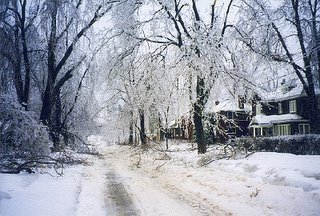
No one expected the mild weather to cause as much havoc as it did. The rain came down innocently atop the trees and houses, but congregated there as ice; indeed, there were few sights more beautiful than those trees which appeared to be encased in glass, shining under the moonlight. Before long, branches of every tree became crystallized in a thick layer of frozen rainwater. Roofs of houses and cars collapsed under the weight of the ice, with the raindrops accumulating to become several inches thick. Trees that stood for hundreds of years succumbed to the ice, and came crashing down to the ground. And as trees all around the city fell victim to the drops of water, they took down large sections of the electrical infrastructure connecting the city. As each power line came down under the weight of nearby trees, another neighbourhood would fall into darkness.
Nearly the entire city was without power, and then a deep freeze fell upon the dimmed city. Temperatures dropped to twenty degrees below zero, and for the hundreds of thousands of residents accustomed to electrical heating, it became nearly impossible to live at home.
For Muslims, that Ramadhan quickly became unforgettable. Already accustomed to going without food and water for entire days, the experience became even more meaningful when other basic necessities were unavailable. Without light, heat, and electricity, families were forced to go about without the lavish meals and elaborate gatherings that generally accompany the breaking of the fast. In everything, simplicity and efficiency were the order of the day, and some of the deeper meanings of Ramadhan became apparent.
We prayed Tarawih prayer by candle light. Every worshipper stood listening to the words of the Quran wrapped in heavy ski jackets, multiple pairs of gloves and socks, toques, and even snowpants. Inside the prayer hall, temperatures were well below zero degrees, but somehow the beauty of the Quran transcended the extreme conditions, and the masjid remained full in spite of the extreme cold and darkness.
In the trying conditions, families came together, sharing whatever provisions they had. With schools and offices closed, it was perhaps the first time that entire families were able to break their fasts together. In the desperate circumstances, the beauty of Ramadhan was experienced fully.
In Ramadhan 1425, in the city of Baghdad, the circumstances were far worse. There was no end in sight to a war that had claimed the lives of thousands of Iraqis. Widespread chaos reigned throughout the country, and there no reason to believe that things would improve anytime soon.
One sister took her family to visit an aunt who had been stricken with depression due to the continuing occupation. At the time, the city of Fallujah was under heavy attack by occupation forces, thus many Fallujah residents fled to Baghdad. It was then that the sister met some relatives among the refugees. She had never met them before, but the war had brought them together in the home of her aunt. They broke their fast together solemnly, discussing the desperate situation. Among the refugees was a mother and some of her children; the father and one son did not make the trip. They stayed back in Fallujah to assist others in escaping the war-torn city, and had not been heard from in days.
It was Ramadhan, however, and the family from Fallujah vowed to remain patient. Abstaining from food and water was the least of their struggles; living under an occupation, with their family divided and without the means to communicate with them were much greater struggles than the traditional hardships associated with fasting. The families ate together and they cried together, while Muslims around the world prayed that their hardships come to an end.
For thousands of Muslims, this will be the first Ramadhan after being afflicted with the most devastating natural disaster in recent history. Countless Muslims died during the Tsunami crisis at the end of 2004, and over a million lost their homes and belongings. Many will never be able to rebuild their lives. For those who had lost homes and families, the hardships of Ramadhan would be insignificant in comparison. However, the qualities of patience, restraint and steadfastness that Ramadhan teaches are that much more important to those who have undergone such hardships. And in the midst of such overwhelming catastrophe, the most dedicated believers will always find courage in their losses and find strength in their weakness.
Today, the focus falls upon the southern United States, in the midst of the most destructive natural disaster in the nations history. Thousands of residents have been forced to evacuate their cities, and thousands more have lost homes and loved ones. In a nation known for its economic and military power and in a city known for its hedonism, the lessons to be learned are multiplied. Accustomed to its apparent invincibility, the devastation caused by the hurricanes will forever leave a stain on the nations pride.
For the sizable Muslim population living in New Orleans, the catastrophe and the consequent relief efforts have made the coming Ramadhan that much more meaningful. One sister, Kelly Izdihar Crosby of New Orleans, found renewed faith through her ordeal, summing up her feelings as follows.
“After facing the wrath of Hurricane Katrina and the ultimate failure of the relief efforts, I feel incredibly blessed that I am alive, happy and healthy. My faith in Allah Ta'ala has been strengthened, and since we had escaped from New Orleans to Atlanta, we have witnessed the sweetness and generousity of those who are sympathetic to our situation. I have seen an outpouring of generousity and sadaqa which reminds me of why Ramadan is so important.
“This year, when you fast, think about the people stranded behind in New Orleans, who were too poor to evacuate, and had nothing to eat for days. Praise Allah Ta'ala that you will probably break your fast with your loved ones, while many do not know where their next meal is coming. And give with a happy heart, as much as you can, for the pleasure of Allah. Allah will return it to you and reward you for your charity. Loan to Allah a beautiful loan. Thank Allah in your prayers this Ramadhan that you are in a clean home, in a dry land, with people who love you and all your possessions at your disposal. I am sad for my city, but thankful that we are safe in Allah's care.”
And we all must be thankful. We must always remind one another of the blessings bestowed upon us by Allah, lest the reminder come crashing down upon us again.
(Irrelevant Note: It would have really been nice if digital cameras were common back during the Ice Storm, because it was so incredibly beautiful and I'd have ice storm pics all over my desktop.)
At first, it seemed like nothing. Ramadhan 1418 had just begun, and with it, the January temperature was unseasonably warm in Montreal. The winter break was coming to an end, so the students began preparing for school while others prepared themselves for returning to their various responsibilities. It was wonderful to begin the holy month of Ramadhan during the holiday season, since families could be together and share in the blessings that only that month could bring. The end of the holidays meant that most of the Ramadhan days would have to be spent in offices or classrooms, and perhaps the spirit of Ramadhan would be lost amid the hectic schedules.
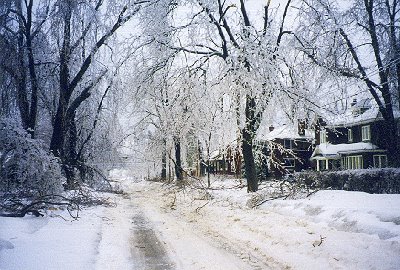
No one expected the mild weather to cause as much havoc as it did. The rain came down innocently atop the trees and houses, but congregated there as ice; indeed, there were few sights more beautiful than those trees which appeared to be encased in glass, shining under the moonlight. Before long, branches of every tree became crystallized in a thick layer of frozen rainwater. Roofs of houses and cars collapsed under the weight of the ice, with the raindrops accumulating to become several inches thick. Trees that stood for hundreds of years succumbed to the ice, and came crashing down to the ground. And as trees all around the city fell victim to the drops of water, they took down large sections of the electrical infrastructure connecting the city. As each power line came down under the weight of nearby trees, another neighbourhood would fall into darkness.
Nearly the entire city was without power, and then a deep freeze fell upon the dimmed city. Temperatures dropped to twenty degrees below zero, and for the hundreds of thousands of residents accustomed to electrical heating, it became nearly impossible to live at home.
For Muslims, that Ramadhan quickly became unforgettable. Already accustomed to going without food and water for entire days, the experience became even more meaningful when other basic necessities were unavailable. Without light, heat, and electricity, families were forced to go about without the lavish meals and elaborate gatherings that generally accompany the breaking of the fast. In everything, simplicity and efficiency were the order of the day, and some of the deeper meanings of Ramadhan became apparent.
We prayed Tarawih prayer by candle light. Every worshipper stood listening to the words of the Quran wrapped in heavy ski jackets, multiple pairs of gloves and socks, toques, and even snowpants. Inside the prayer hall, temperatures were well below zero degrees, but somehow the beauty of the Quran transcended the extreme conditions, and the masjid remained full in spite of the extreme cold and darkness.
In the trying conditions, families came together, sharing whatever provisions they had. With schools and offices closed, it was perhaps the first time that entire families were able to break their fasts together. In the desperate circumstances, the beauty of Ramadhan was experienced fully.
In Ramadhan 1425, in the city of Baghdad, the circumstances were far worse. There was no end in sight to a war that had claimed the lives of thousands of Iraqis. Widespread chaos reigned throughout the country, and there no reason to believe that things would improve anytime soon.
One sister took her family to visit an aunt who had been stricken with depression due to the continuing occupation. At the time, the city of Fallujah was under heavy attack by occupation forces, thus many Fallujah residents fled to Baghdad. It was then that the sister met some relatives among the refugees. She had never met them before, but the war had brought them together in the home of her aunt. They broke their fast together solemnly, discussing the desperate situation. Among the refugees was a mother and some of her children; the father and one son did not make the trip. They stayed back in Fallujah to assist others in escaping the war-torn city, and had not been heard from in days.
It was Ramadhan, however, and the family from Fallujah vowed to remain patient. Abstaining from food and water was the least of their struggles; living under an occupation, with their family divided and without the means to communicate with them were much greater struggles than the traditional hardships associated with fasting. The families ate together and they cried together, while Muslims around the world prayed that their hardships come to an end.
For thousands of Muslims, this will be the first Ramadhan after being afflicted with the most devastating natural disaster in recent history. Countless Muslims died during the Tsunami crisis at the end of 2004, and over a million lost their homes and belongings. Many will never be able to rebuild their lives. For those who had lost homes and families, the hardships of Ramadhan would be insignificant in comparison. However, the qualities of patience, restraint and steadfastness that Ramadhan teaches are that much more important to those who have undergone such hardships. And in the midst of such overwhelming catastrophe, the most dedicated believers will always find courage in their losses and find strength in their weakness.
Today, the focus falls upon the southern United States, in the midst of the most destructive natural disaster in the nations history. Thousands of residents have been forced to evacuate their cities, and thousands more have lost homes and loved ones. In a nation known for its economic and military power and in a city known for its hedonism, the lessons to be learned are multiplied. Accustomed to its apparent invincibility, the devastation caused by the hurricanes will forever leave a stain on the nations pride.
For the sizable Muslim population living in New Orleans, the catastrophe and the consequent relief efforts have made the coming Ramadhan that much more meaningful. One sister, Kelly Izdihar Crosby of New Orleans, found renewed faith through her ordeal, summing up her feelings as follows.
“After facing the wrath of Hurricane Katrina and the ultimate failure of the relief efforts, I feel incredibly blessed that I am alive, happy and healthy. My faith in Allah Ta'ala has been strengthened, and since we had escaped from New Orleans to Atlanta, we have witnessed the sweetness and generousity of those who are sympathetic to our situation. I have seen an outpouring of generousity and sadaqa which reminds me of why Ramadan is so important.
“This year, when you fast, think about the people stranded behind in New Orleans, who were too poor to evacuate, and had nothing to eat for days. Praise Allah Ta'ala that you will probably break your fast with your loved ones, while many do not know where their next meal is coming. And give with a happy heart, as much as you can, for the pleasure of Allah. Allah will return it to you and reward you for your charity. Loan to Allah a beautiful loan. Thank Allah in your prayers this Ramadhan that you are in a clean home, in a dry land, with people who love you and all your possessions at your disposal. I am sad for my city, but thankful that we are safe in Allah's care.”
And we all must be thankful. We must always remind one another of the blessings bestowed upon us by Allah, lest the reminder come crashing down upon us again.
(Irrelevant Note: It would have really been nice if digital cameras were common back during the Ice Storm, because it was so incredibly beautiful and I'd have ice storm pics all over my desktop.)
October 09, 2005
On Open Hearts and Empty Stomachs
As part of my ongoing laziness in writing new stuff, plus the fact that I'm busy with Ramadan, I've pulled out an old article I wrote. Originally published in the July 2005 issue of Muslim Link.
During the lifetime of Rasulullah SAW, generousity and self-sacrifice were common qualities. Numerous volumes have been written about the kindness of the companions of the Prophet SAW, and many scholars have spoken about their distinctive qualities. Today, however, we have reduced these inspiring episodes to mere stories that do not apply in modern life. But if one looks at these incidents in depth, one can appreciate their lessons more thoroughly, and recognize how far we have lagged behind.
One such incident was that of a Sahabi who volunteered to entertain a guest of Rasulullah SAW. The guest came to Rasulullah SAW complaining of hunger and distress, but the Prophet had no food available at the time. A man from among the Ansar of Madinah offered to take the guest, and brought him to his home. He informed his wife about his promise to feed the guest, though his wife informed him that there was only enough food in the house to feed the children.
The Sahabi had promised Rasulullah SAW that he would entertain the guest, and so he instructed his wife to put their children to sleep without food. With the children asleep, he sat the guest down and put out the lamp in a feigned effort to adjust it appropriately. With the lights out, he pretended to eat along, while feeding the guest with all the little that they had. The whole family went hungry so that the guest could enjoy the meal.
There are several lessons to take from this incident. First of all, it should be noted that the Sahabi did not know the guest. Today, we will often be ready to help our family and friends in need, but are unwilling to help a stranger, even though he may be Muslim and in greater need.
Another noteworthy point from this story was that the Sahabi did not even know whether he even had enough food for the guest, yet he was still not reluctant to offer his help. Nowadays, before we are willing to open our hearts, we check our wallets and our bank accounts, and then consult our calendars to see if we have time. We are willing to help out only when doing so will not inconvenience ourselves.
Things are changing, however. A number of local initiatives have done wonders to improve the condition of people around the world, both Muslim and non-Muslim. Poverty and hunger continue to be among the most significant afflictions in the Muslim world, but devoted members of the community are doing their part to assist those in need. The past year has seen local Muslims going hungry to raise money for food banks, fundraisers for disaster-stricken regions, and numerous campaigns to fight poverty.
The onus then lies on ourselves to stop waiting for the perfect opportunity when the conditions are favourable for helping, but rather give ourselves to the will of Allah SWT in any condition. Even if one can do little, no contribution is insignificant when done with the right intention. If we claim to be following the footsteps of our Prophet and his companions, we must recognize that those footsteps pushed forward even when the tides were pushing against them.
During the lifetime of Rasulullah SAW, generousity and self-sacrifice were common qualities. Numerous volumes have been written about the kindness of the companions of the Prophet SAW, and many scholars have spoken about their distinctive qualities. Today, however, we have reduced these inspiring episodes to mere stories that do not apply in modern life. But if one looks at these incidents in depth, one can appreciate their lessons more thoroughly, and recognize how far we have lagged behind.
One such incident was that of a Sahabi who volunteered to entertain a guest of Rasulullah SAW. The guest came to Rasulullah SAW complaining of hunger and distress, but the Prophet had no food available at the time. A man from among the Ansar of Madinah offered to take the guest, and brought him to his home. He informed his wife about his promise to feed the guest, though his wife informed him that there was only enough food in the house to feed the children.
The Sahabi had promised Rasulullah SAW that he would entertain the guest, and so he instructed his wife to put their children to sleep without food. With the children asleep, he sat the guest down and put out the lamp in a feigned effort to adjust it appropriately. With the lights out, he pretended to eat along, while feeding the guest with all the little that they had. The whole family went hungry so that the guest could enjoy the meal.
There are several lessons to take from this incident. First of all, it should be noted that the Sahabi did not know the guest. Today, we will often be ready to help our family and friends in need, but are unwilling to help a stranger, even though he may be Muslim and in greater need.
Another noteworthy point from this story was that the Sahabi did not even know whether he even had enough food for the guest, yet he was still not reluctant to offer his help. Nowadays, before we are willing to open our hearts, we check our wallets and our bank accounts, and then consult our calendars to see if we have time. We are willing to help out only when doing so will not inconvenience ourselves.
Things are changing, however. A number of local initiatives have done wonders to improve the condition of people around the world, both Muslim and non-Muslim. Poverty and hunger continue to be among the most significant afflictions in the Muslim world, but devoted members of the community are doing their part to assist those in need. The past year has seen local Muslims going hungry to raise money for food banks, fundraisers for disaster-stricken regions, and numerous campaigns to fight poverty.
The onus then lies on ourselves to stop waiting for the perfect opportunity when the conditions are favourable for helping, but rather give ourselves to the will of Allah SWT in any condition. Even if one can do little, no contribution is insignificant when done with the right intention. If we claim to be following the footsteps of our Prophet and his companions, we must recognize that those footsteps pushed forward even when the tides were pushing against them.
October 03, 2005
Reminder proves beneficial for the believers
Message of Ramadhan - alBalagh
Ramadan - The Muslim Reformer - Jamiyatul Ulama Canada
Sighting the Hilal - Jamiyatul Ulama Canada
Ramadan Warriors - Shaikh Muhammad alShareef
Narrated Abu Hurairah (RadhiAllahu'anh) : Allah's Messenger (Sallalaho'alayhi wa salam) said, "When any one of you is observing Saum (fasting) on a day, he should neither indulge in obscene language nor should he raise the voice; and if anyone reviles him or tries to quarrel with him, he should say 'I am observing fast.'" (Bukhari, Muslim)
Ramadan - The Muslim Reformer - Jamiyatul Ulama Canada
Sighting the Hilal - Jamiyatul Ulama Canada
Ramadan Warriors - Shaikh Muhammad alShareef
Narrated Abu Hurairah (RadhiAllahu'anh) : Allah's Messenger (Sallalaho'alayhi wa salam) said, "When any one of you is observing Saum (fasting) on a day, he should neither indulge in obscene language nor should he raise the voice; and if anyone reviles him or tries to quarrel with him, he should say 'I am observing fast.'" (Bukhari, Muslim)
July 21, 2005
July 11, 2005
May 17, 2005
Subscribe to:
Posts (Atom)