This happened over a week ago, but since everyone found this story funny when I told them in person, it has now officially been relegated to an Irrelevant Opinion. Generally, I'll try to keep work-related stuff out of here, but this is an exception.
I was working on the integration of a third party tool into the system we were developing for the federal government. We had been waiting for months for the company to deliver this product, and finally last week, they told us that it was ready to be tested. We scheduled a conference call between a few of us from our company, with the third party vendor joining us from locations in Toronto and Arizona. I had not met any of these people previously, and didn't know most of their names either.
So after everyone introduced themselves on the call, someone asked: "Do we have a jew on the line?" I gasped, perplexed by the question. "Not yet," another replied.
Later, after our test failed, I was told to "touch base with a Jew" before I continue with my testing. I was confused, but didn't inquire further.
Finally, someone else joined the call. He had a heavy Indian accent, and introduced himself to the rest of us on the conference call.
"Hey everyone, this is Aju."
Finally, it all made sense. A few hours later, I was explaining to others within our company how to conduct the tests I had just run. When I told them to "get in touch with a Jew before you move forward," I was greeted with lots of furrowed brows - their confusion was probably amplified since this was being explained to them by a devout Muslim with a thick beard.
Ah, multiculturalism at work! It's a beautiful thing.
November 11, 2005


October 30, 2005
Strength in Weakness
I wrote this just a couple of weeks before the October 8th earthquake, as it was to be included in the Ramadhan issue of Muslim Link. I was fortunate to get in touch with one sister from New Orleans to provide an Islamic perspective to the devastation caused by Hurricane Katrina, and referred to Baghdad Burning for the Iraqi perspective on Ramadhan. As I wrote this over a month ago, it might appear slightly outdated with emphasis put on Hurricane Katrina and not on the greater tragedies that have occurred since then, but this blog is called Irrelevant Opinions, so I suppose that's okay. The themes I touched upon for this article are better illustrated by the efforts of the Pakistani relief workers and the resilience of the victims, but here's my essay anyway (slightly edited from the published version.)
At first, it seemed like nothing. Ramadhan 1418 had just begun, and with it, the January temperature was unseasonably warm in Montreal. The winter break was coming to an end, so the students began preparing for school while others prepared themselves for returning to their various responsibilities. It was wonderful to begin the holy month of Ramadhan during the holiday season, since families could be together and share in the blessings that only that month could bring. The end of the holidays meant that most of the Ramadhan days would have to be spent in offices or classrooms, and perhaps the spirit of Ramadhan would be lost amid the hectic schedules.
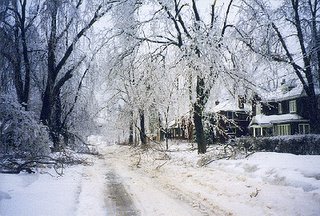
No one expected the mild weather to cause as much havoc as it did. The rain came down innocently atop the trees and houses, but congregated there as ice; indeed, there were few sights more beautiful than those trees which appeared to be encased in glass, shining under the moonlight. Before long, branches of every tree became crystallized in a thick layer of frozen rainwater. Roofs of houses and cars collapsed under the weight of the ice, with the raindrops accumulating to become several inches thick. Trees that stood for hundreds of years succumbed to the ice, and came crashing down to the ground. And as trees all around the city fell victim to the drops of water, they took down large sections of the electrical infrastructure connecting the city. As each power line came down under the weight of nearby trees, another neighbourhood would fall into darkness.
Nearly the entire city was without power, and then a deep freeze fell upon the dimmed city. Temperatures dropped to twenty degrees below zero, and for the hundreds of thousands of residents accustomed to electrical heating, it became nearly impossible to live at home.
For Muslims, that Ramadhan quickly became unforgettable. Already accustomed to going without food and water for entire days, the experience became even more meaningful when other basic necessities were unavailable. Without light, heat, and electricity, families were forced to go about without the lavish meals and elaborate gatherings that generally accompany the breaking of the fast. In everything, simplicity and efficiency were the order of the day, and some of the deeper meanings of Ramadhan became apparent.
We prayed Tarawih prayer by candle light. Every worshipper stood listening to the words of the Quran wrapped in heavy ski jackets, multiple pairs of gloves and socks, toques, and even snowpants. Inside the prayer hall, temperatures were well below zero degrees, but somehow the beauty of the Quran transcended the extreme conditions, and the masjid remained full in spite of the extreme cold and darkness.
In the trying conditions, families came together, sharing whatever provisions they had. With schools and offices closed, it was perhaps the first time that entire families were able to break their fasts together. In the desperate circumstances, the beauty of Ramadhan was experienced fully.
In Ramadhan 1425, in the city of Baghdad, the circumstances were far worse. There was no end in sight to a war that had claimed the lives of thousands of Iraqis. Widespread chaos reigned throughout the country, and there no reason to believe that things would improve anytime soon.
One sister took her family to visit an aunt who had been stricken with depression due to the continuing occupation. At the time, the city of Fallujah was under heavy attack by occupation forces, thus many Fallujah residents fled to Baghdad. It was then that the sister met some relatives among the refugees. She had never met them before, but the war had brought them together in the home of her aunt. They broke their fast together solemnly, discussing the desperate situation. Among the refugees was a mother and some of her children; the father and one son did not make the trip. They stayed back in Fallujah to assist others in escaping the war-torn city, and had not been heard from in days.
It was Ramadhan, however, and the family from Fallujah vowed to remain patient. Abstaining from food and water was the least of their struggles; living under an occupation, with their family divided and without the means to communicate with them were much greater struggles than the traditional hardships associated with fasting. The families ate together and they cried together, while Muslims around the world prayed that their hardships come to an end.
For thousands of Muslims, this will be the first Ramadhan after being afflicted with the most devastating natural disaster in recent history. Countless Muslims died during the Tsunami crisis at the end of 2004, and over a million lost their homes and belongings. Many will never be able to rebuild their lives. For those who had lost homes and families, the hardships of Ramadhan would be insignificant in comparison. However, the qualities of patience, restraint and steadfastness that Ramadhan teaches are that much more important to those who have undergone such hardships. And in the midst of such overwhelming catastrophe, the most dedicated believers will always find courage in their losses and find strength in their weakness.
Today, the focus falls upon the southern United States, in the midst of the most destructive natural disaster in the nations history. Thousands of residents have been forced to evacuate their cities, and thousands more have lost homes and loved ones. In a nation known for its economic and military power and in a city known for its hedonism, the lessons to be learned are multiplied. Accustomed to its apparent invincibility, the devastation caused by the hurricanes will forever leave a stain on the nations pride.
For the sizable Muslim population living in New Orleans, the catastrophe and the consequent relief efforts have made the coming Ramadhan that much more meaningful. One sister, Kelly Izdihar Crosby of New Orleans, found renewed faith through her ordeal, summing up her feelings as follows.
“After facing the wrath of Hurricane Katrina and the ultimate failure of the relief efforts, I feel incredibly blessed that I am alive, happy and healthy. My faith in Allah Ta'ala has been strengthened, and since we had escaped from New Orleans to Atlanta, we have witnessed the sweetness and generousity of those who are sympathetic to our situation. I have seen an outpouring of generousity and sadaqa which reminds me of why Ramadan is so important.
“This year, when you fast, think about the people stranded behind in New Orleans, who were too poor to evacuate, and had nothing to eat for days. Praise Allah Ta'ala that you will probably break your fast with your loved ones, while many do not know where their next meal is coming. And give with a happy heart, as much as you can, for the pleasure of Allah. Allah will return it to you and reward you for your charity. Loan to Allah a beautiful loan. Thank Allah in your prayers this Ramadhan that you are in a clean home, in a dry land, with people who love you and all your possessions at your disposal. I am sad for my city, but thankful that we are safe in Allah's care.”
And we all must be thankful. We must always remind one another of the blessings bestowed upon us by Allah, lest the reminder come crashing down upon us again.
(Irrelevant Note: It would have really been nice if digital cameras were common back during the Ice Storm, because it was so incredibly beautiful and I'd have ice storm pics all over my desktop.)
At first, it seemed like nothing. Ramadhan 1418 had just begun, and with it, the January temperature was unseasonably warm in Montreal. The winter break was coming to an end, so the students began preparing for school while others prepared themselves for returning to their various responsibilities. It was wonderful to begin the holy month of Ramadhan during the holiday season, since families could be together and share in the blessings that only that month could bring. The end of the holidays meant that most of the Ramadhan days would have to be spent in offices or classrooms, and perhaps the spirit of Ramadhan would be lost amid the hectic schedules.
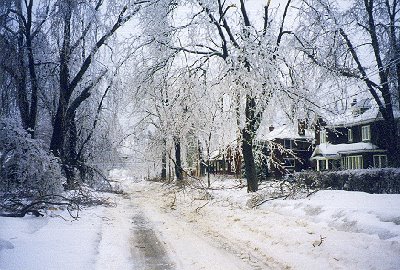
No one expected the mild weather to cause as much havoc as it did. The rain came down innocently atop the trees and houses, but congregated there as ice; indeed, there were few sights more beautiful than those trees which appeared to be encased in glass, shining under the moonlight. Before long, branches of every tree became crystallized in a thick layer of frozen rainwater. Roofs of houses and cars collapsed under the weight of the ice, with the raindrops accumulating to become several inches thick. Trees that stood for hundreds of years succumbed to the ice, and came crashing down to the ground. And as trees all around the city fell victim to the drops of water, they took down large sections of the electrical infrastructure connecting the city. As each power line came down under the weight of nearby trees, another neighbourhood would fall into darkness.
Nearly the entire city was without power, and then a deep freeze fell upon the dimmed city. Temperatures dropped to twenty degrees below zero, and for the hundreds of thousands of residents accustomed to electrical heating, it became nearly impossible to live at home.
For Muslims, that Ramadhan quickly became unforgettable. Already accustomed to going without food and water for entire days, the experience became even more meaningful when other basic necessities were unavailable. Without light, heat, and electricity, families were forced to go about without the lavish meals and elaborate gatherings that generally accompany the breaking of the fast. In everything, simplicity and efficiency were the order of the day, and some of the deeper meanings of Ramadhan became apparent.
We prayed Tarawih prayer by candle light. Every worshipper stood listening to the words of the Quran wrapped in heavy ski jackets, multiple pairs of gloves and socks, toques, and even snowpants. Inside the prayer hall, temperatures were well below zero degrees, but somehow the beauty of the Quran transcended the extreme conditions, and the masjid remained full in spite of the extreme cold and darkness.
In the trying conditions, families came together, sharing whatever provisions they had. With schools and offices closed, it was perhaps the first time that entire families were able to break their fasts together. In the desperate circumstances, the beauty of Ramadhan was experienced fully.
In Ramadhan 1425, in the city of Baghdad, the circumstances were far worse. There was no end in sight to a war that had claimed the lives of thousands of Iraqis. Widespread chaos reigned throughout the country, and there no reason to believe that things would improve anytime soon.
One sister took her family to visit an aunt who had been stricken with depression due to the continuing occupation. At the time, the city of Fallujah was under heavy attack by occupation forces, thus many Fallujah residents fled to Baghdad. It was then that the sister met some relatives among the refugees. She had never met them before, but the war had brought them together in the home of her aunt. They broke their fast together solemnly, discussing the desperate situation. Among the refugees was a mother and some of her children; the father and one son did not make the trip. They stayed back in Fallujah to assist others in escaping the war-torn city, and had not been heard from in days.
It was Ramadhan, however, and the family from Fallujah vowed to remain patient. Abstaining from food and water was the least of their struggles; living under an occupation, with their family divided and without the means to communicate with them were much greater struggles than the traditional hardships associated with fasting. The families ate together and they cried together, while Muslims around the world prayed that their hardships come to an end.
For thousands of Muslims, this will be the first Ramadhan after being afflicted with the most devastating natural disaster in recent history. Countless Muslims died during the Tsunami crisis at the end of 2004, and over a million lost their homes and belongings. Many will never be able to rebuild their lives. For those who had lost homes and families, the hardships of Ramadhan would be insignificant in comparison. However, the qualities of patience, restraint and steadfastness that Ramadhan teaches are that much more important to those who have undergone such hardships. And in the midst of such overwhelming catastrophe, the most dedicated believers will always find courage in their losses and find strength in their weakness.
Today, the focus falls upon the southern United States, in the midst of the most destructive natural disaster in the nations history. Thousands of residents have been forced to evacuate their cities, and thousands more have lost homes and loved ones. In a nation known for its economic and military power and in a city known for its hedonism, the lessons to be learned are multiplied. Accustomed to its apparent invincibility, the devastation caused by the hurricanes will forever leave a stain on the nations pride.
For the sizable Muslim population living in New Orleans, the catastrophe and the consequent relief efforts have made the coming Ramadhan that much more meaningful. One sister, Kelly Izdihar Crosby of New Orleans, found renewed faith through her ordeal, summing up her feelings as follows.
“After facing the wrath of Hurricane Katrina and the ultimate failure of the relief efforts, I feel incredibly blessed that I am alive, happy and healthy. My faith in Allah Ta'ala has been strengthened, and since we had escaped from New Orleans to Atlanta, we have witnessed the sweetness and generousity of those who are sympathetic to our situation. I have seen an outpouring of generousity and sadaqa which reminds me of why Ramadan is so important.
“This year, when you fast, think about the people stranded behind in New Orleans, who were too poor to evacuate, and had nothing to eat for days. Praise Allah Ta'ala that you will probably break your fast with your loved ones, while many do not know where their next meal is coming. And give with a happy heart, as much as you can, for the pleasure of Allah. Allah will return it to you and reward you for your charity. Loan to Allah a beautiful loan. Thank Allah in your prayers this Ramadhan that you are in a clean home, in a dry land, with people who love you and all your possessions at your disposal. I am sad for my city, but thankful that we are safe in Allah's care.”
And we all must be thankful. We must always remind one another of the blessings bestowed upon us by Allah, lest the reminder come crashing down upon us again.
(Irrelevant Note: It would have really been nice if digital cameras were common back during the Ice Storm, because it was so incredibly beautiful and I'd have ice storm pics all over my desktop.)
October 22, 2005
“Ramathon”
Ramadhan is a particularly interesting time of year in the West because religious expression extends over the course of the whole day. As a result, questions will always arise in classrooms and workplaces, such as "Why aren't you coming out with us for lunch? How come you're leaving work at this time? Why are you never home in the evenings?"
Some answer with awkwardness or deliberation, and fail to provide good answers. Consequently, an excellent opportunity for educating people about Islam becomes lost. This feeling generally prevails when we develop a sense of disconnect from the lives and practices of non-Muslims; we feel that since we don't want to be involved with their activities, we don't them involved in our activities. Unfortunately, this only further alienates the community, and makes it harder for such opportunities to arise again in the future. This is a major problem within the Muslim community, and needs to change.
In the past, I've always been fairly up front regarding my beliefs and practices, but this year I wanted to take it a step further. Weeks before Ramadhan began, I started talking about it around the office, in elevators, and wherever else would I find myself. I work for a large consulting firm, and before Ramadhan began, my whole team knew about it and kept asking if it had begun yet.
So when it finally did, I was amazed when some of my non-Muslim colleagues expressed interest in fasting for a day themselves. I did not need to convince anyone or even encourage them, but of their own volition, they agreed to try it at least once. This was an opportunity not only to help others become more understanding of Muslims, but to engage them in a Muslim experience. To this end, I contacted the Ottawa Food Bank to turn this day of fasting into a charity event, where my whole team would fast, and others would contribute to a worthy cause in support of it. I was calling it Fast-a-thon, as the event was similar to ones organized by some MSA's with that name, but others called it Ramathon as an homage to the month of Ramadhan.
We set the day of fasting to be Wednesday, October 19th. I did not want the fasting to affect the productivity of my colleagues, so I told them that they could cheat if they really needed to, but they insisted on going through with it fully. On that day, they all woke up at 5:30am for an early meal, and then fasted from just before 6:00am to sunset at 6:14pm. They even avoided brushing their teeth during the hours of fasting, something many Muslims fail to do even though it is considered to be makruh, or undesirable. (See here.)
Two of them could not get by without at least water, so they drank throughout the course of the day. Even then, they strictly avoided any other drink entirely. The rest made the full fast until sunset. Most of them found it very difficult, with one wondering whether just licking an apple would break the fast. In the end, they made it through, and we broke our fast with dates and Timbits.
One noted, "It's strange we never see Faraz complaining about this."
Another replied, "Yeah, but he's got Allah."
Throughout the day, there was a buzz around the office, with everyone asking about the progress of the fast and the charity efforts; we had two donation boxes set up around the office and another at a client site. In the end, we raised just over 250$ for the Ottawa Food Bank, an impressive amount considering our rushed preparation. In spite of the fact that it was very difficult for most of the non-Muslim fasters, some were already talking about holding such an event next year with better preparation and more participation.
The Fastathon website expresses their vision as one of a nation as one that is not only accepting of Islam and Muslims, but one that is better because of them. This should be the vision of all Muslims living in North America. We tend to complain about injustice and intolerance and condemn whatever we find condemnable, but we have done very little to alleviate the problems. We lose ourselves in rhetoric, and our action falls short as a result. In the past, entire nations accepted Islam not because they were simply tolerant of it, but because they realized that society as a whole was better with Islam.
Huge thanks go out to CC, TT, TB, and JM for their patience, support, and dedication! And thanks to everyone else who helped out in supporting the event! I know at least some of you read this.
October 15, 2005
The Earthquake
I had been to Northern Pakistan a few years ago, and it really is the most beautiful place I have seen in my life. It was not uncommon to see mountains rooted in flowing streams of sparkling, cold spring water that you could drink right from the ground. Looking out any window was like looking at a beautiful painting.
Many of the people I met there were even more beautiful. They were some of the most humble, hospitable gentlemen I have ever met, and they treated us with so much respect and kindness. I imagine most of the areas I visited were heavily affected by the earthquake; I expect that those same people are now mourning and trying to salvage whatever they can of their possessions and food. On my way to that city, I recall driving alongside mountains for several hours on narrow, curvy roads - our driver kept freaking us out by taking the sharp turns at high speeds, with no barrier between the road and the cliff. I imagine that it must be incredibly difficult to bring food and supplies to those areas via those roads; hopefully there are enough helicopters to cover all the remote areas.
Human Concern International has begun their campaign, and so have a number of other organizations. It is Ramadhan, so let us all try to be charitable insha-Allah!
A few relevant links:
- CBC News has some excellent photo galleries which give an idea of the scale of this disaster.
- Izzy Mo has a very interesting article on why bad things happen.
- My second cousin in Pakistan has an eloquent and emotional post about her feelings on the disaster.
- SAFspace has a touching piece on why we should contribute to relief efforts.
October 09, 2005
On Open Hearts and Empty Stomachs
As part of my ongoing laziness in writing new stuff, plus the fact that I'm busy with Ramadan, I've pulled out an old article I wrote. Originally published in the July 2005 issue of Muslim Link.
During the lifetime of Rasulullah SAW, generousity and self-sacrifice were common qualities. Numerous volumes have been written about the kindness of the companions of the Prophet SAW, and many scholars have spoken about their distinctive qualities. Today, however, we have reduced these inspiring episodes to mere stories that do not apply in modern life. But if one looks at these incidents in depth, one can appreciate their lessons more thoroughly, and recognize how far we have lagged behind.
One such incident was that of a Sahabi who volunteered to entertain a guest of Rasulullah SAW. The guest came to Rasulullah SAW complaining of hunger and distress, but the Prophet had no food available at the time. A man from among the Ansar of Madinah offered to take the guest, and brought him to his home. He informed his wife about his promise to feed the guest, though his wife informed him that there was only enough food in the house to feed the children.
The Sahabi had promised Rasulullah SAW that he would entertain the guest, and so he instructed his wife to put their children to sleep without food. With the children asleep, he sat the guest down and put out the lamp in a feigned effort to adjust it appropriately. With the lights out, he pretended to eat along, while feeding the guest with all the little that they had. The whole family went hungry so that the guest could enjoy the meal.
There are several lessons to take from this incident. First of all, it should be noted that the Sahabi did not know the guest. Today, we will often be ready to help our family and friends in need, but are unwilling to help a stranger, even though he may be Muslim and in greater need.
Another noteworthy point from this story was that the Sahabi did not even know whether he even had enough food for the guest, yet he was still not reluctant to offer his help. Nowadays, before we are willing to open our hearts, we check our wallets and our bank accounts, and then consult our calendars to see if we have time. We are willing to help out only when doing so will not inconvenience ourselves.
Things are changing, however. A number of local initiatives have done wonders to improve the condition of people around the world, both Muslim and non-Muslim. Poverty and hunger continue to be among the most significant afflictions in the Muslim world, but devoted members of the community are doing their part to assist those in need. The past year has seen local Muslims going hungry to raise money for food banks, fundraisers for disaster-stricken regions, and numerous campaigns to fight poverty.
The onus then lies on ourselves to stop waiting for the perfect opportunity when the conditions are favourable for helping, but rather give ourselves to the will of Allah SWT in any condition. Even if one can do little, no contribution is insignificant when done with the right intention. If we claim to be following the footsteps of our Prophet and his companions, we must recognize that those footsteps pushed forward even when the tides were pushing against them.
October 03, 2005
Reminder proves beneficial for the believers
Message of Ramadhan - alBalagh
Ramadan - The Muslim Reformer - Jamiyatul Ulama Canada
Sighting the Hilal - Jamiyatul Ulama Canada
Ramadan Warriors - Shaikh Muhammad alShareef
Narrated Abu Hurairah (RadhiAllahu'anh) : Allah's Messenger (Sallalaho'alayhi wa salam) said, "When any one of you is observing Saum (fasting) on a day, he should neither indulge in obscene language nor should he raise the voice; and if anyone reviles him or tries to quarrel with him, he should say 'I am observing fast.'" (Bukhari, Muslim)
September 25, 2005
As if things aren't crazy enough
Flipper the firing dolphin let loose by Katrina | Guardian Unlimited
This seems like a joke, but somehow my brains satire filter did not register this one.
This seems like a joke, but somehow my brains satire filter did not register this one.
September 23, 2005
Rhyme-adan
I've been rather busy over the last week, so instead of writing something new and meaningful, I'm just going to recycle a silly poem I wrote last year for the Ramadhan issue of Muslim Link.
We have come again upon that time of the year
Yes, certainly the month of Ramadan is near
So to Allahs teachings we must adhere
Fasting has been ordained to attain unto fear
The Prophet, on whom be peace, said on the last of Sha'baan
As narrated in Bayhaqi by the trusted companion Salman,
Telling the companions that a great month was in sight
And better than a thousand months in just one blessed night.
The gates of Paradise are open, gates of Hell are closed
Among the bounties that the Prophet disclosed
And as our beloved Prophet explained
In this blessed month, the devils are chained
So for one full month, Muslims celebrate
By virtuous actions, not by what they ate
Breaking their fasts with a simple date
And still somehow end up gaining weight
It is a test of patience and self-restraint
To abstain from food without complaint
To leave routine during the entire day
To worship and reflect, and especially pray
It is to give to the poor, to show we care
It is to pray at night, the Tarawih prayer
It is to learn respect and learn to share
It is to give up comfort without despair
Obscene language must go, for those who cursed
And if you lie, you might as well also quench your thirst
For fasting is not just about the food and drink
It is about our conduct, our actions, the way we think
In a narration by Muslim, the Prophet reported
That fasting will be exclusively rewarded,
While rewards for other deeds are generally known
The reward for fasting is with Allah, and Allah alone
Fasting is a shield, so let us defend ourselves well
If we live another year, only Allah can tell
September 13, 2005
Another eventful elevator ride
On returning from Isha prayer in the basement, the elevator opened up on the main floor. In walked a Chinese woman, two other Muslims, one of whom is a friend of mine, and Mr. White-Anglo Fascist. He had the usual scoul on his face, and appeared poised to make himself look like an idiot all over again.
My friend who was in the elevator with me was a big guy, not the type of guy you would want to mess around with. The White Anglo looked at his position in the elevator, and muttered to himself, "Looks like I'm a f**king minority in here."
"Where are you boys from?" he asked me. I casually replied that I was from Ottawa, which he could not quite swallow. "No f**king way you're from Ottawa. I'm from Ottawa." I was born in Montreal, I told him. That seemed to annoy him even more, so I told him that I'm historically from India. To this, he muttered a lot of expletives, but I don't think he felt safe attacking me directly with the other Muslims in the elevator. In particular, he probably felt threatened by the bigger guy, who I had engaged in small talk with as he started swearing at us. The two other Muslims got off before me, so it was just the white anglo, the Chinese woman, and myself left.
Then he launched his verbal assault, blabbering on about Jesus and Muhammad not existing, and how we've all been deceived, and that's what is causing war, us "f**king towelheads and Christians." The Chinese woman looked visibly upset, though said nothing. We reached her floor, and she got off. The white anglo then unleashed a barrage of ignorance regarding China and Chinese people. I told him to keep his opinions to himself.
He was to get off at the fifteenth floor. On reaching his floor, however, he had started saying terrible things regarding the Prophets of Allah, and how we were to blame for all that was wrong in the world. He told me that everything I believed in was bullplop, though his choice of vocabulary was less polite. He held the elevator door open and did not leave, only so he could belittle everything I hold to heart with his mindless nonsense.
"Religion is to blame for all the f**king nonsense going on right now." I replied that it was not religion in particular, it was intolerance. He asked me what I believed; I told him that I'll keep my beliefs to myself if he keeps his beliefs to himself.
"Have you heard of Nostradamus?"
"I believe you've already asked me that," I replied.
"Yeah? And what did you say?" I didn't say much last time, but by this point I was quite annoyed, and wanted him to get out and let me get back to my apartment. I quietly supplicated that Allah SWT take care of this situation for me before things got out of hand.
Then the elevator door started closing on him, and he got stuck in the middle. He tried pushing it back open, but could not; the elevator kept closing in on him. I replied to his Nostradamus question, telling him that I never heard Nostradamus say it was a good idea to get stuck in elevator doors. He started cursing, so I pressed the button to open the door. The door opened, and he clenched his arm in pain. He looked at me with malice, and turned towards the hallway.
I called out, as I did before, "Have a nice night!" He did not swear at me this time, but instead muttered incoherently. I was alone in the elevator now; the door closed, and I proceeded up towards my floor.
September 12, 2005
A Brief History of Decline
Over 1400 years have passed since Rasulullah SAW stood at Mount Arafah, and addressed his companions for the final time. The beloved Messenger of Allah began by appealing to the hearts of the people by calling upon their reverence of that holy day of Arafah, reminding them that they must also revere each and every Muslim. He reminded them that they must respect the sanctity and honour of the Muslim people just as they respect the sanctity and honour of Makkah, of the Ka'aba. He called upon them to deliver that message, as well as the entire message he gave his life for, to all those unable to accompany him at that time.
And so the companions set forth, not in search of treasure or land, but in search of those unfortunate people who were unable to hear the message of the Messenger of Allah SWT directly. They carried their message to all the corners, wherever they might expect to find someone to hear the message - and many places where they did not expect to find anyone at all. But they went on either way, because the message was so important. They pushed onwards into the unknown, for years and years.
Many did not even return to their homes. The message entrusted to them was too valuable to afford them time in other than the propagation of it. It was that message, after all, that elevated them to the heights of spiritual and moral excellence, after spending generations living in depravity and chaos. They endured extreme conditions of hunger, exhaustion, torment and pain for that message; it was not something they would take lightly ever again.
And so they mounted their camels and called all those they encountered to the way of their beloved Prophet, peace be upon him. In the absence of the transportation readily available today, they delivered the message throughout much of the entire known world through tremendous physical strain and hardship. Their graves are scattered in locations many thousands of miles across, but the message they conveyed did not die with them. It endured and prospered for many generations, and has now been left to us.
And now, whenever injustice occurs in the world, the Muslims have to defend themselves. Whenever acts of hatred claims the lives of innocent people, the Muslims are blamed for it. Whenever civil liberties are threatened, the Muslims fall back into the same refrain of apology and regret. Muslims are being tortured and blown apart at the core, and the ummah is in shambles.
With the Muslims under attack from every corner, one would expect that we would at least be united in defending our beliefs and our values. One would expect that with such merciless agression against us, we would stick up for one another, and develop compassion amongst ourselves.
Instead, we exhaust ourselves in belittling one another. Rather than discuss issues in a constructive manner, we instead seek to point out errors in the views of others. Every group is trying to "expose" the wrongdoings and miscalculations of the other groups. Each one of them believes they have the exclusive right to call themselves the follower of the Prophet, peace be upon him, yet the rhetoric of each group is eerily the same - and nearly all of it contrary to the teachings of compassion and tolerance that our Prophet taught.
The heart of the Muslim world, the lands of the Prophet (peace be upon him), has been ruptured. The Hajj has become a business and spirituality is declining. Racism is rampant, with Africans suffering from hunger, poverty and mutilation, while the locals look down upon them with derision. The air is thick with the stench of the thousands of smokers who have no problem with exercising their disgusting habit in the vicinity of the Ka'aba. Unlawful food is being sold and consumed by those sincere foreigners who have assumed that everything there must be halaal. At the site of the first revelation of Quran, a merchant will dress you up in traditional Arab garb and take a picture of you pretending to supplicate to Allah for five riyaals.
And most of the rest of us are oblivious to all this, because we feel that attending some lecture and yelling at some rally is all we need to do. Instead of addressing our concerns amongst our companions and community where we can actually do something productive, we rant to strangers under the title of Irrelevant Opinions. Still, we feel good inside because Muslim organizations are working hard to break stereotypes plaguing our community; after all, the world must know that we too can sing and dance.
How has it come to this?
September 07, 2005
August 31, 2005
Breaking some stereotypes, enforcing others
I was browsing the web for information regarding the upcoming ISNA conference in Chicago. I never go to ISNA conferences, but wanted to keep abreast of the latest happenings to get an idea of the scale of the event. This eventually lead me to the infamous Naseeb.com site, which I've heard much about but have never visited before.

Anyway, it has always bothered me that in spite of all our efforts to promote Islam in North America and in spite of the extremely educated Muslim population living here, we still can't spell. There, on the front page of this famous website, is a typo, in a sentence claiming that American Muslims will be breaking stereotypes. I love the irony.

Anyway, it has always bothered me that in spite of all our efforts to promote Islam in North America and in spite of the extremely educated Muslim population living here, we still can't spell. There, on the front page of this famous website, is a typo, in a sentence claiming that American Muslims will be breaking stereotypes. I love the irony.
August 25, 2005
Google Manipulation
It's old news that a search for the word "failure" on Google returns the biography of President Bush as the first result. This works because numerous people have linked to that page using the words "Failure" or "Miserable Failure" as the link text.
Bush supporters, unable to think of something original, decided to counter this Google manipulation by using the same trick to push Michael Moore to the top of the search results for that same query. Currently, his webpage ranks second on the word "Failure". First of all, I find it funny that Bush supporters find Michael Moore to be their greatest enemy, and not an actual political figure who could actually have some real influence.
Anyway, even with this attack on Michael Moore, the Bush supporters have lost again, as I discovered today. By virtue of what is probably some server-side scripting on www.michaelmoore.com, whenever someone tries to visit the Michael Moore website from the Google "Failure" search results, it will redirect the user back to the website of George Bush. Hilarious!
August 23, 2005
Speculations on Google Talk
The web has been abuzz with rumours of Google releasing their own Instant Messaging service, which they are calling Google Talk. Only mere days after they released Google Desktop 2, which puts a multitude of Google and web services on your desktop without need for a browser, Google seems poised to release a competitor for the IM services of MSN, Yahoo, AOL, etc. It appears as if the service is already live, though the Google client software is not yet available.
There are probably already too many IM services as it is, but history has shown that Google always goes several steps beyond what anyone thought was possible. Much of the innovation on the web today can be attributed directly to Google. With that being said, these are the types of services I expect Google to eventually include in their IM client if they do in fact release one.
VoIP. It's pretty certain that this is part of their plan, as Yahoo has launched a competing service, and I think MSN is working on it.
Integration with Google Desktop 2. I imagine that your contact list will be neatly stored as a module for Google Desktop 2, leaving no need for another program running as the client.
Integration with GMail, which will double as a voicemail box and the central contact list (all available from Google Desktop 2). Like Skype, I expect users to be able to have actual phone numbers that people can call and leave voice messages. Incidentally, Yahoo introduced a very similar service 5 years ago by the name of Yahoo By Phone, which provided users with a 10-digit extension that can be reached at by a toll-free Yahoo number. Yahoo By Phone used to also be able to read your mail out for you, so you could literally check your e-mail from any payphone.
Integration with Google Local, Google Maps, and Google Earth. I expect that some day, I can click on a location on Google Maps and have it automatically place a call to that location. You can almost do this already with the Vonage "Click2Call" service, which provides a couple of web services that make it extremely easy to automatically dial any number. Unfortunately, the service is not available to Vonage Canada customers like me just yet.
Voice-based ads. There is a service in Ottawa where you can pick up a payphone, call a toll-free number, listen to a short ad, and then make a local call. It saves you the quarter if you're not in a hurry and don't mind listening to a couple of short ads. I expect Google to employ a similar revenue scheme for their service, perhaps delivered when checking your voicemail.
Integration with Blogger and AudioBlogger, which will allow a person to quickly publish a voice or text conversation to their blog or podcast. They can also receive instant messages whenever a comment is posted on their blog, which they could then reply to immediately through the Google Talk interface.

So let's see how much of this actually happens. And remember, you heard it here first!
There are probably already too many IM services as it is, but history has shown that Google always goes several steps beyond what anyone thought was possible. Much of the innovation on the web today can be attributed directly to Google. With that being said, these are the types of services I expect Google to eventually include in their IM client if they do in fact release one.
So let's see how much of this actually happens. And remember, you heard it here first!
August 12, 2005
As the ink dries
The same night I encountered the "white-anglo" who insisted I should address him as sir, I also witnessed a violent scuffle between a few other people. Some guys who live in my building had gotten into an argument with the Chinese convenience store owner over something trivial, and started smashing the windows of the store.
The Chinese man, enraged, chased the kids outside, where the kids all started attacking him jointly, kicking and taunting him. I happened to be passing by at the time, and pulled one of the kids aside and spoke with him. He was a Muslim kid, a pretty nice guy who tends to find himself in the wrong crowd all the time. He pulled away from the fight, and eventually the others dispersed. Shortly afterwards, police arrived at the scene. By that point, I was long gone enjoying my meal at the nearby Somali restaurant.
Though the dispute was a trivial one, the violence erupted largely due to racial differences. As I witnessed myself shortly afterwards, racism still exists in our society all over the place. Over the last little while, somehow, it has become even more apparent especially within my own neighbourhood.
For the first few months after I moved into this building, there was quite a bit of vandalism on the walls and elevators, with most of it aimed at the large Bengali community in my area. Recently, all the elevators were redone, and for once they were clean and racism-free. Last week though, the vandalism started again; as I was taking the elevator to go down to the musalla, I saw the words "f***ing muslims" written on my elevator.
Thankfully, the building administration dealt with it promptly, and it was removed the next day. As I went down for Isha today, however, all the elevators had been freshly filled with more anti-Muslim and anti-Bengali vulgarity; the ink must be drying now as I write this. As I returned from prayers, I got into a discussion with the guy riding the elevator with me.
"Man, there's still so much racism, eh?", he asked me.
"Yeah, unfortunately. The administration has been very prompt in cleaning it up, though," I replied.
I reached my floor, and thought about the inaccuracy of what I had just said. The administration can clean non-erasable ink, but they can't clean up the hatred of the hearts.
August 09, 2005
No thank you
I had just come back from a restaurant with my cousin when I witnessed another case of the racism that still unfortunately exists in this great country.
I was on my way back to my apartment building. I reached in my pocket to get my keys to open the front door, but this man got to his keys first and so he opened it instead. So me and my cousin walked through the door. The man then yells at us, "YOU'RE WELCOME."
I looked back at him, and he looked angry, presumably because I didn't thank him for unlocking the door.
"Haven't you f**king ever heard of manners?", he asked me. I smiled as I found that comment deliciously ironic.
I apologized for not thanking him for getting to the door first, and we all got in the elevator.
"You guys better f'in learn some manners," he reminded us in the elevator.
"Alright sir, I'll keep that in mind," I told him.
"That's right, f**k. SIR. Especially I'm a white-anglo in this country, so you f**kin' better be calling me sir. It's all going to hell, just like Nostradamus said. It's gonna end where it began."
After some more incoherent muttering and expletives, he reached his floor.
"Have a nice night, sir!", I called out.
"F**k off."
Man dies after marathon video game session | CBC News
He quit his job for this!
When 'Izraeel comes to take your soul, there's really nothing you can do at that point. May we all be saved from leaving the world in such a state.
When 'Izraeel comes to take your soul, there's really nothing you can do at that point. May we all be saved from leaving the world in such a state.
August 08, 2005
August 07, 2005
Isti-car-a
I have recently been in the market for a car. While I'm not too knowledgeable about cars, I have been thinking for some time about what a car means to someone and how it defines a person. There are so many factors to consider, but perhaps the first thing that I began thinking about was deciding between an import or a local model. They both have their pros and cons.
I find these days that a lot of my friends have decided to go with imports. Most of the people I know who imported were highly pragmatic people, with no intention of portraying a certain image with their car. They just wanted to have a car to go from one place to another, and not have their lives defined by it. Many of them have been with their cars for some time now, and while there are the occasional problems (often because foreign cars may not be well accustomed to local roads and weather conditions), they have never complained. The cars are reliable, safe, and have their own inner beauty.
At the same time, the foreign car has certain limitations. Often, they tend to be more expensive. While the cost of materials may be cheaper, when you add in the freight and other charges, it adds up. Whenever anything goes wrong with the car, it can often be a very expensive task to get things back in shape. Also, they often have certain quirks that cannot be dealt with appropriately in North America. Sometimes the part you need can only be found back at the manufacturer abroad; that makes maintenance quite expensive. Granted, they generally need less maintenance overall.
As for North American cars, the options are much more limited. To find a good domestic car is not an easy endeavour, but it may be worth the effort in the long run. Domestic models tend to be built for the surrounding environment, thus often making them more suitable for many people. The initial purchase of these cars tend to be cheaper, informed advice is more readily available regarding their particularities, and parts are generally cheaper. If anything goes considerably wrong, you would not need to go far for service.
While the cost of parts may be cheaper, these cars tend to need maintenance more often. In many ways, they tend to be more expensive even though the initial purchase cost may be less. Sometimes these machines are built more for style and image than performance, which becomes noticeable after some time. Even then, people I know with these cars end up spending even more money on maintaining the style than on ensuring decent performance.
One friend of mine frequently urges me to go with a North American car in order to support the local market. Too often, he says, people go out and buy foreign cars and then the North American market suffers. He reminds me that people living abroad don't buy North American cars much, so if we don't support our own local economy, the entire system will suffer as a whole.
I've also received advice going the other way, that a foreign car is the best option. One friend keeps on telling me that if I went ahead and settled with a foreign car, I'd be much happier for it. He reminded me that owning a North American car would make it difficult to spend my money on things important to me, since so much would end up going into maintaining the car. I recently even visited a foreign dealership where salespeople worked very hard on convincing me of the benefits of their machines, though nothing I saw then interested me.
In my family, I've seen both. My eldest brother has settled comfortably with a North American Cavalier, while my two other brothers have foreign cars. Overall, they all seem really happy with their cars, so I guess it really just depends on one's own personality. At this point, I have no idea which option would be better for me.
August 02, 2005
'A miracle' no deaths as Air France flight skids off runway, burns in Toronto | CBC News
No deaths on Air France 358
Amid all the chaos and tragedy in the world today, good things still happen once in a while. I was at work when this first happened, and initially we were told that few were likely to survive. The fact that no one died at all is truly a blessing and a miracle.
May Allah SWT continue to protect Canada and it's people from harm and calamity.
Subscribe to:
Posts (Atom)